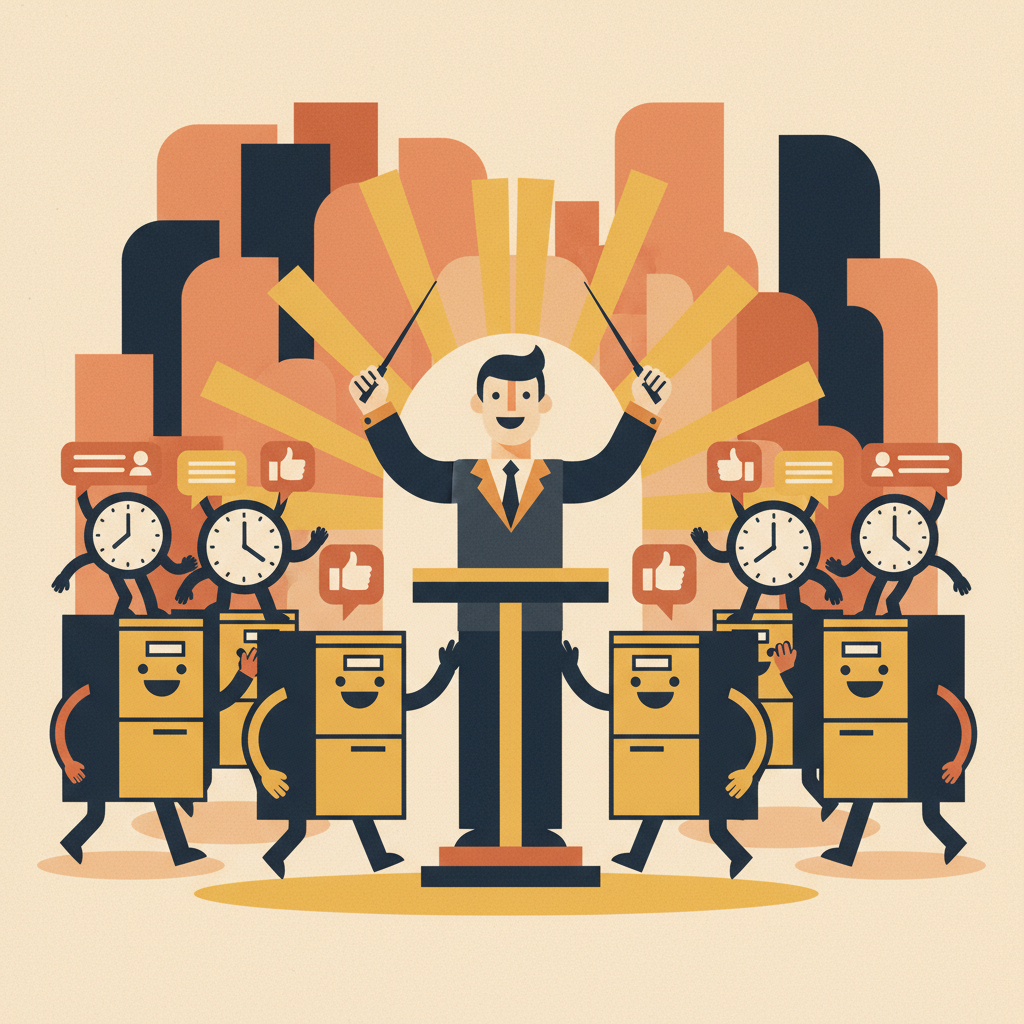
The average knowledge worker spends 62% of their day on context assembly, status updates, and information routing. Not thinking. Not deciding. Not creating. Assembling. At a fully-loaded cost of $85/hour, that is $110,000 per employee per year burned on work a machine should do. That is insanity.
Now multiply that across a 50-person team. That is $5.5M a year you are paying skilled professionals to do clerical work. Five and a half million dollars in loaded salary, disappearing into Slack threads, status decks, meeting prep, and the quiet misery of Ctrl+C/Ctrl+V between six browser tabs. If an investor told you they were burning $5.5M a year on a line item that produced no customer value, you would pull the plug on the fund by Friday. Yet you tolerate it in your own operation because it has always been there. Orchestration is not a nice-to-have. It is the structural fix to a hole in the bottom of your P&L.
You use AI to summarize a doc. Draft an email. Generate a code snippet. You count these as wins. Meanwhile your care coordinator still pulls patient data from four systems before every review. Your ops lead still spends a full day routing tasks that should route themselves. Your product designer still burns 20 minutes re-establishing context everyone should already have.
Look -- you automated the easy parts. The hard parts -- the information assembly, the routing logic, the decision preparation -- are still entirely manual. You are playing poker and folding every strong hand before the flop.
The builder who figures out orchestration does not just use AI. They build the machine that makes everyone around them 10x more effective. That is not an incremental improvement. That is a completely different chip stack.
Picture this. You wake up tomorrow and your inbox already has the synthesis. Your standup deck is already drafted. The five decisions waiting for you each have a one-page brief with the relevant data, the trade-offs, and the recommendation already pressure-tested against last quarter's results. You sit down with coffee and you're not assembling anymore - you're deciding. That is what a single day of orchestrated work feels like. Now multiply that by 250 days a year. That is the gap.
┌─────────────────────────────────────────────────────────────────────────────────┐
│ │
│ ● HOW MOST PEOPLE USE AI TODAY ● HOW A 100x OPERATOR USES AI │
│ │
│ LEVEL 1: Task Replacement LEVEL 2: Decision Preparation │
│ │
│ You ──→ "Summarize this" ┌─────────────────────────────┐ │
│ You ──→ "Draft that email" │ OVERNIGHT ORCHESTRATION │ │
│ You ──→ "Generate this code" │ │ │
│ │ Pull customer feedback ██ │ │
│ Saves minutes. │ Cross-ref with roadmap ██ │ │
│ Then you spend 3 hours │ Map to priorities ██░ │ │
│ manually assembling context │ Flag anomalies ██░ │ │
│ for the actual decision. │ Assemble 2-page brief │ │
│ │ │ │
│ ┌──────────────────┐ └─────────────┬───────────────┘ │
│ │ 70% assembly │ ↓ │
│ │ 30% judgment │ You walk in with full context. │
│ │ That's backwards │ You make the decision. │
│ └──────────────────┘ 30 min standup → 12 min. │
│ │
│ ─ ─ ─ ─ ─ ─ ─ ─ ─ ─ ─ ─ ─ ─ ─ ─ ─ ─ ─ ─ ─ ─ ─ ─ ─ ─ ─ ─ ─ ─ ─ ─ ─ ─ ─ ─ ─ ─ │
│ │
│ CAREER IMPACT CAREER IMPACT │
│ You do tasks AI assigns. You build the machine. │
│ Interchangeable. The machine makes everyone │
│ around you 10x more effective. │
│ │
│ │
│ BUSINESS IMPACT BUSINESS IMPACT │
│ Patchwork automations. End-to-end workflow engine. │
│ New overhead managing Dead time between decisions │
│ disconnected pieces. eliminated. 3x throughput. │
│ │
│ │
└─────────────────────────────────────────────────────────────────────────────────┘
The 100x Individual
Here's the thing. There are only two levels of AI usage, and the difference between them is the difference between a 2% return and a 200% return on your time investment.
- Task replacement -- write this, summarize that, generate this code. Saves minutes. This is where 99% of people stop. It is a rounding error on your productivity.
- Decision preparation -- before you sit down to make a call, your AI has already assembled the context, surfaced the data, identified patterns, and flagged the anomalies. This is where the 1% lives. This is the compounding position.
The shift from level 1 to level 2 changes everything. Think of it like seat position in poker -- same cards, radically different outcomes based on when you act and what information you hold. Level 2 means you always act last, with full information.
A product manager deployed this exact pattern and the ROI was immediate. Each morning his AI reviews overnight customer feedback, cross-references it with the roadmap, maps patterns to existing priorities, and assembles a 2-page brief.
How to build your first overnight brief: Set up a Zapier or n8n flow that triggers daily at 6am. Connect it to your data sources - Slack channels, your CRM, your analytics dashboard API. Have the flow compile key updates into a single document, then feed that into Claude via API to synthesize a decision-ready brief. Alternatively, use Dust.tt to create an agent that pulls from Notion, Slack, and Linear automatically - you configure the data sources once and the brief assembles itself every morning. He walks into standup holding cards nobody else has seen. Standup dropped from 30 minutes to 12 -- not because the meeting got shorter, but because the first 18 minutes of context assembly vanished. But here's what matters more than the time savings: he now uses that reclaimed time for the deep product thinking that actually differentiates - sitting with customer problems, pressure-testing positioning, designing experiments worth running. Time to decision, faster. Time to market, faster. And time for the hardest, most interesting product problems? Unlocked. That is $47,000 in reclaimed team hours per year redirected to the work that actually moves the needle. From one workflow.
A product designer applied the same principle to her review process. Before each design review, her AI pulls persona data, maps UX flows against user research, references similar patterns from the design system, and flags accessibility and IA issues. She walks in ready to make strategic calls instead of spending 20 minutes re-establishing context. Net-net: she reclaimed 7 hours per week - not just for shipping more, but for the deep craft work that generic output can never touch. Information architecture decisions. Interaction design nuance. The hard UX problems nobody else has time to sit with. Those 7 hours are where the real differentiation happens. That compounds.
An engineering lead has AI pre-assemble context for every ticket -- product rationale, design decisions, technical constraints, related past work. Engineers start building on day 1 of the sprint instead of day 3. Sprint velocity increased 30% without a single additional hour worked. Tell me another investment that returns 30% with zero incremental cost.
A clinical coordinator has AI pre-assemble complete patient context before every encounter. History, trends, flags, decision-relevant data -- assembled automatically. Prep dropped from 45 minutes to 5. That is an 89% reduction. Decision quality went up because no context gets missed.
A founder running 12 simultaneous projects uses AI agents with orchestration logic. Each project's context flows automatically -- no manual status updates, no coordination meetings, no information lost between channels. She focuses on strategy because the machine handles coordination. The punchline is she replaced $180,000 worth of project management overhead with $200/month in AI tooling.
A sales manager orchestrated her entire weekly 1:1 prep. Before each meeting, her AI pulls every deal the rep touched, every call they ran, every email they sent, and every pipeline movement in the last seven days. It assembles a one-page brief flagging stalled deals, coaching moments, and red flags she would otherwise miss. Prep dropped from 90 minutes per rep to 5. Across 8 reps, that is 11 hours reclaimed every week - and the quality of her coaching went up because she stopped making decisions on stale memory. Her reps started closing 18% more deals within a quarter because the coaching actually connected to reality.
A customer success lead built an orchestration layer that watches every account for churn signals - usage drops, support ticket spikes, sentiment shifts in email - and surfaces a proactive outreach brief before the customer even thinks about leaving. She intervenes a week earlier than she used to. Her gross retention moved from 88% to 94% in two quarters. On $20M ARR, that is $1.2M a year saved. From one orchestration flow. That is the kind of ROI that reshapes the entire department's headcount math.
What's stopping you from building one overnight brief this week? Not the tooling - it exists and it's cheap. Not the skill - you can wire a basic flow in an afternoon. The thing in the way is the belief that the manual assembly is "your job." It isn't. It is the tax you pay for not having built the machine yet. Pick one recurring decision. Automate the assembly. Walk in tomorrow holding cards nobody else has seen. Do it once and you will never go back.
The shift: from "AI does the task" to "AI prepares me for the decision." You still make the calls. You still apply the judgment. AI doesn't replace your role - it extends your reach. The value is the triad: you, your knowledge store, and AI working as one system. Your agents build with you, carrying your context into every workflow. You're not outsourcing your decision-making. You're eliminating the busywork before it. That is not optimization. That is a fundamentally different job with fundamentally different leverage.
The 100x Team & Business
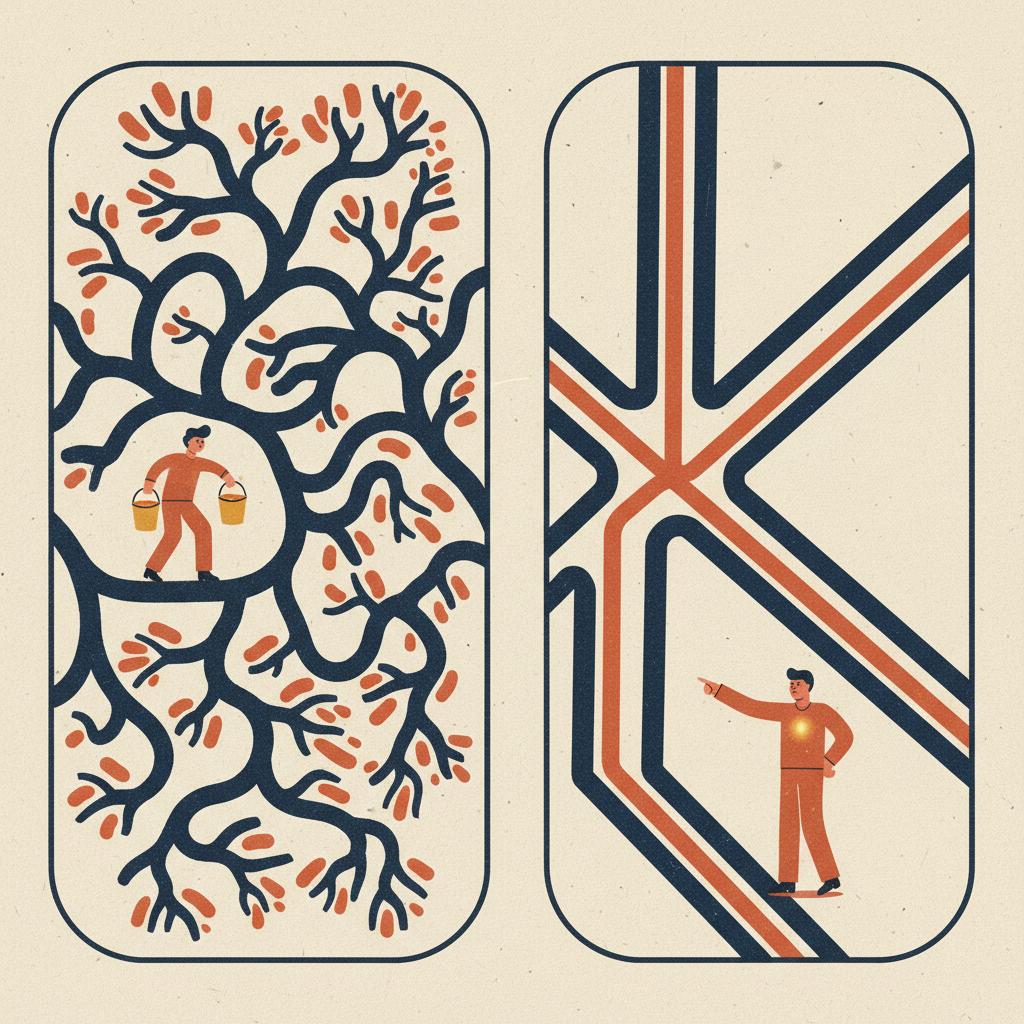
What does orchestration look like when you zoom out from one person to an entire team? The returns compound even faster -- but only if you deploy it correctly.
Most teams approach AI bottom-up. Automate Task A. Automate Task B. Call it transformation. But the workflow between A and B -- the routing, the conditional logic, the exception handling -- is still manual. You have built a patchwork of disconnected automations that creates a new kind of overhead. Let me be very clear: that is duct tape masquerading as infrastructure. It does not scale.
The orchestration approach starts with the workflow itself. Map the end-to-end process first. Design the decision points. Build the routing logic. Then layer AI into each step where it adds value. That is the sequence. Anything else is burning money.
Think about it like this. If you were building a factory, you wouldn't start by buying the most expensive robot you could find and plugging it in somewhere. You would design the assembly line first - the sequence, the handoffs, the quality gates, the throughput constraints. Then you would decide which stations need automation and which need skilled humans. Every manufacturer learned this lesson 50 years ago. Most knowledge-work teams in 2026 are still buying robots and hoping the assembly line emerges on its own. It does not. The teams that treat AI deployment like factory design are lapping the teams that treat it like shopping.
One company built an event-driven orchestration engine for patient care. Medical data and patient interactions trigger conditional workflows automatically. Not simple "if this, then that" -- complex chains with multiple decision branches, escalation paths, and human checkpoints. A patient's reading triggers a cascade: check medication history, compare with baseline trends, assess against protocols, route to the appropriate clinician with full context attached.
How to map your first orchestration workflow: Open a blank doc and list every step in one recurring process - say, sprint planning. For each step, write who does it, what information they need, and where that information currently lives. Now circle the steps that are pure context assembly. Those are your first automation targets. Build them in Zapier Central, n8n, or Notion automations - start simple, add AI at specific steps, and keep human review at decision points.
The critical design decision -- and this is where most teams get it wrong: start with humans in the loop, then layer in automation. Tasks route to humans first. The ops team sees what works, refines the logic, builds confidence in the system. Only then does AI-driven automation enter at specific steps. You derisk before you deploy. Same principle as underwriting -- you do not write the policy until you understand the exposure.
Think about it like this. You wouldn't ask a surgeon to spend 45 minutes pulling charts before every operation. You wouldn't ask a pilot to manually compile weather data before every takeoff. The system prepares them so they can focus on the parts only they can do. Why would you accept anything less for the highest-leverage decisions in your business? The orchestration layer is the pre-flight check that makes the actual work possible.
The result: the clinician still makes the clinical decision -- but walks in holding every card they need. Context assembly dropped from 45 minutes to 5. Decision quality went up. Throughput increased 3x without adding headcount. And those 40 reclaimed minutes per encounter? They go to the work that actually matters - the complex clinical reasoning, the patient relationship, the nuanced cases that demand deep thinking. The team isn't just moving faster. They have time for the hardest, most meaningful work in their field. That is not a 3% improvement. That is a 3x multiple on the same cost base with a fundamental shift in how clinicians spend their time.
Here is the uncomfortable truth: AI cannot be trusted alone. Every AI output requires human review. The 20 minutes of back-and-forth refinement per task is not overhead -- it is the quality layer that prevents the organization from shipping garbage. The orchestration engine routes AI output to the right human reviewer -- PM, product designer, engineer, clinical lead -- with the right context for a quality check. Full stop.
Imagine if your team's review capacity became the actual bottleneck rather than the assembly work that precedes it. That is a profoundly better problem to have. Review is where judgment lives - it is the part of the job worth paying a senior professional for. Assembly is a cost center. Orchestration moves the constraint from "how fast can we assemble" to "how fast can we decide," and decisions are where the value is. The team that figures out this reframe stops measuring output in tasks completed and starts measuring it in decisions made. That is a fundamentally different scorecard, and it is the only one that matters at scale.
One Pattern, Every Domain
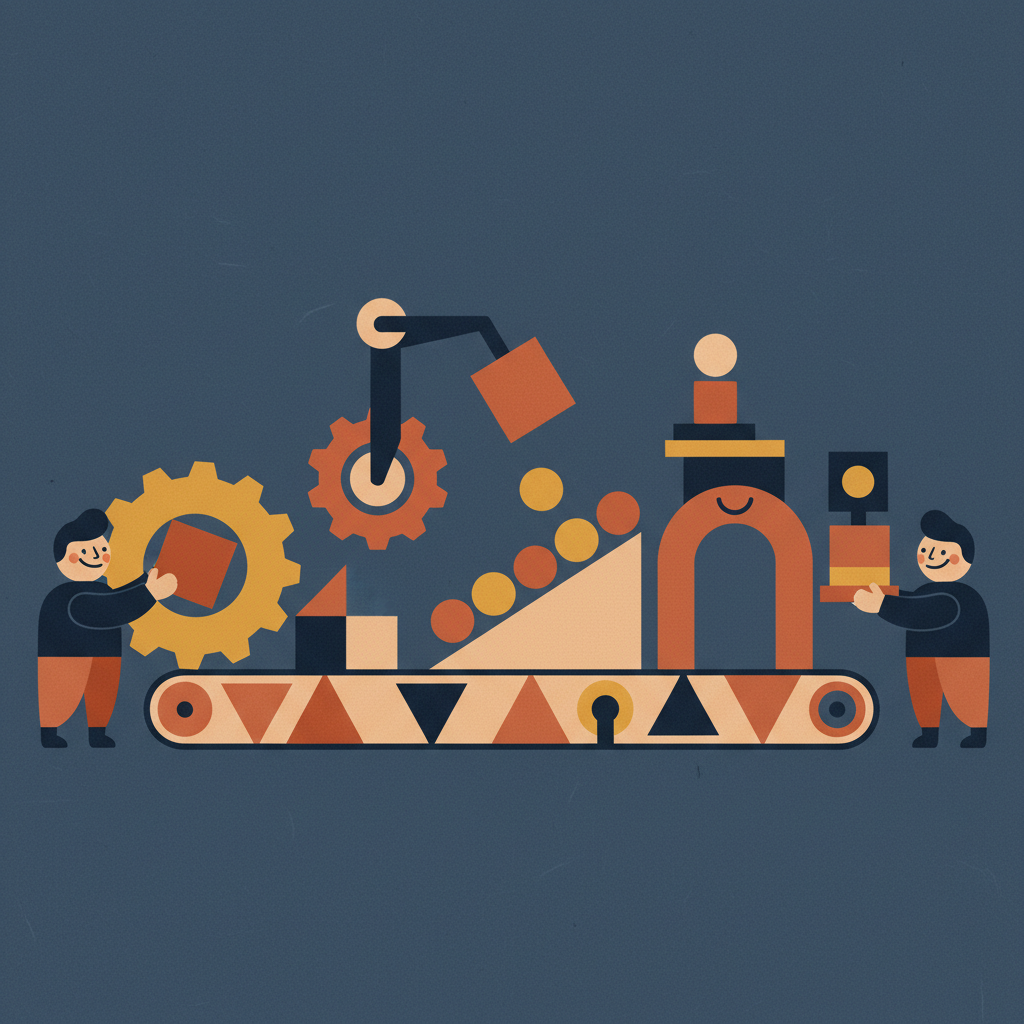
Why does orchestration work the same way everywhere? Because the waste is the same everywhere: dead time between decisions. Every minute spent assembling context before a decision is a minute with zero ROI. Orchestration eliminates it.
A sales operations team orchestrated deal reviews. Before each pipeline meeting, AI assembles account context from CRM data, email history, call transcripts, and competitive intelligence. The sales leader walks in reading the table instead of building it. Pipeline reviews went from 90-minute data-gathering sessions to 30-minute strategy discussions. That is $312,000 in reclaimed senior leadership time per year across a 20-person sales org.
A product design team orchestrated UX research synthesis. User interviews get transcribed, themes extracted, patterns mapped to personas, and conflicts with prior research flagged -- before the researcher opens their analysis tool. The job shifted from "find the patterns" to "validate and deepen the patterns the system found." That is a fundamentally higher-leverage position.
A clinical intake team orchestrated new patient onboarding. Data flows through verification, pre-authorization, history assembly, and team assignment -- each step triggered by the previous one, with human checkpoints at the three most critical decisions. Average intake time dropped from 4 hours to 45 minutes. That is an 81% reduction with better outcomes.
An engineering team orchestrated incident response. When an alert fires, AI pre-assembles the relevant logs, recent deploys, service dependencies, and past incidents with similar signatures. The on-call engineer starts diagnosing immediately instead of spending 30 minutes assembling context at 3am. MTTR dropped 60%. At scale, that compounds into millions in prevented downtime.
A finance team orchestrated the month-end close. Journal entries route through automatic validation, anomaly detection, and cross-system reconciliation before any human touches them. The controller used to spend 9 days on close every month. She now spends 3, and the quality of the review is dramatically higher because she is reviewing pre-flagged exceptions instead of hunting for them in a sea of rows. That is 6 days per month reclaimed for forecasting, strategic analysis, and the actual job a controller should be doing at a growth-stage company. $75,000 a year in reclaimed senior finance time, and a faster board pack every month.
A recruiting operations team orchestrated their candidate pipeline. Inbound resumes get parsed, cross-referenced against open roles, scored against each hiring manager's historical preferences, and routed with a summary attached. The recruiter reviews 40 pre-ranked candidates in 30 minutes instead of sorting through 200 in a day. Time-to-first-interview dropped from 11 days to 3. For a company hiring 50 roles a year, that is the difference between losing top candidates to faster competitors and closing them before anyone else even calls.
The pattern: the dead time between decisions is where humans waste most of their working hours - grinding on assembly instead of doing the work that actually makes a difference. Orchestration eliminates the grind. It doesn't just make you faster - it gives you back hours for deep thinking, deep craft, and the hardest most interesting problems in your domain. Time to decision, faster. Time to idea, faster. And time for the strategic depth that no amount of speed can replace? Unlocked. You become the person who builds the machine and then uses the reclaimed time for the work only a human can do. That is the seat at the table you want.
Imagine if every recurring decision in your business arrived at your desk pre-assembled - the customer signals, the data, the tradeoffs, the precedent from last time, the recommendation pressure-tested against your usual filters. Your job is no longer "gather context, then decide." Your job is just decide. The grunt work that used to consume 70% of your week vanishes. The strategic work that always got pushed to "next quarter" becomes the work you actually have time for. What does your career look like when 70% of your hours are spent on decisions instead of preparation? That is the question every operator in your field should be asking right now.
Where This Connects
Orchestration is the engine connecting everything -- and like any engine, its output depends on its inputs and its transmission.
Your knowledge base provides the context the engine draws on. Your hub-and-spoke architecture gives it the flexibility to route work across any tool. Your AI-native team are the humans making the decisions the engine prepares them for. Your performance standards measure the outcomes the engine optimizes toward.
Knowledge without orchestration is a library nobody reads. Orchestration without knowledge is a machine running empty. Either without the builder directing them is noise at scale. The value is the triad: you, your knowledge store, and AI working together. Your agents extend your capacity - they don't replace your judgment. The builder who connects all three creates a system that compounds -- getting smarter and faster with every cycle. That is not a marginal improvement. That is the whole game.
Examples How Others Have Made This Real
These aren't hypotheticals. Real teams are building orchestration engines that eliminate dead time between decisions - and the tools to do it are production-ready.
Zapier Central lets teams build AI-powered workflows where each step feeds the next with full context. A customer inquiry triggers research, the research feeds a draft response, the draft routes to a human for review - all connected, zero manual handoffs. Operations teams are replacing day-long routing work with flows that run in minutes.
n8n + Claude - engineering and ops teams build event-driven orchestration pipelines where AI handles context assembly, synthesis, and routing. A support ticket triggers automatic log analysis, customer history lookup, and a proposed fix - assembled before the engineer even opens the ticket. One team cut incident triage time by 70%.
Dust.tt provides team-level AI orchestration - agents that draw from connected data sources (Notion, Slack, GitHub, CRM) and prepare decision-ready briefs automatically. Product teams use Dust agents to assemble sprint context overnight. The PM walks in Monday morning holding full context instead of spending the morning building it.
Temporal + AI workflows - engineering teams orchestrate complex, multi-step AI processes with built-in reliability. A patient data change triggers verification, cross-reference, protocol check, and clinician notification - each step conditional on the last, with human checkpoints at critical decisions. Healthcare companies run this pattern in production today.
Linear's auto-triage uses AI to classify, prioritise, and route incoming issues based on project context, team capacity, and historical patterns. The engineering lead reviews pre-sorted, pre-contextualised work instead of manually routing 40 tickets every morning. Dead time between "issue reported" and "engineer starts work" compressed from days to minutes.
Anthropic's own internal workflows chain Claude calls with tool use - web search, code execution, file analysis - into multi-step pipelines where each step's output feeds the next. The pattern works for any team: research → synthesis → draft → human review, all connected, all context-preserving.
Notion automations + AI - product teams set up flows where a new customer call note automatically triggers insight extraction, persona mapping, and roadmap tagging. The PM doesn't "remember to update the knowledge base" - the system does it as a byproduct of normal work. That's orchestration at its simplest and most powerful.
Ask Yourself
These questions reveal whether you're using AI for the easy parts and still doing the hard parts by hand.
Are you at Level 1 or Level 2? Level 1: AI does tasks you assign (summarize this, draft that). Level 2: AI prepares you for decisions before you sit down. If you're still assigning tasks instead of receiving pre-assembled context, you're leaving the real leverage untouched. See what Level 2 orchestration looks like →
What context do you manually assemble before every recurring decision? Sprint planning. Design reviews. Patient encounters. Pipeline meetings. List the ritual. Now ask: could AI have assembled 80% of that context overnight? If yes, that's dead time waiting to be eliminated.
Are your automations connected - or are they a patchwork? Task A is automated. Task B is automated. But does A's output feed B automatically? Or do you still manually route between them? Disconnected automations are duct tape, not orchestration. See how the hub connects everything →
Where are the human checkpoints in your workflows? If the answer is "nowhere" - you're trusting AI alone, and you shouldn't be. If the answer is "everywhere" - you're bottlenecking on human review. The right design has checkpoints at the 3-5 most critical decision points. Not more, not fewer.
Can multiple agents and team members work on the same thing seamlessly? When your PM's AI finishes a brief, does it flow to the product designer's AI with full context? Or does someone copy-paste between tools? Orchestration means the machine routes work - not the humans. Explore how shared surfaces dissolve walls between tools →
What's the dead time between your biggest recurring decisions? Measure it. That's the orchestration opportunity. Every minute of context assembly before a decision is a minute AI should have handled. See the full framework →