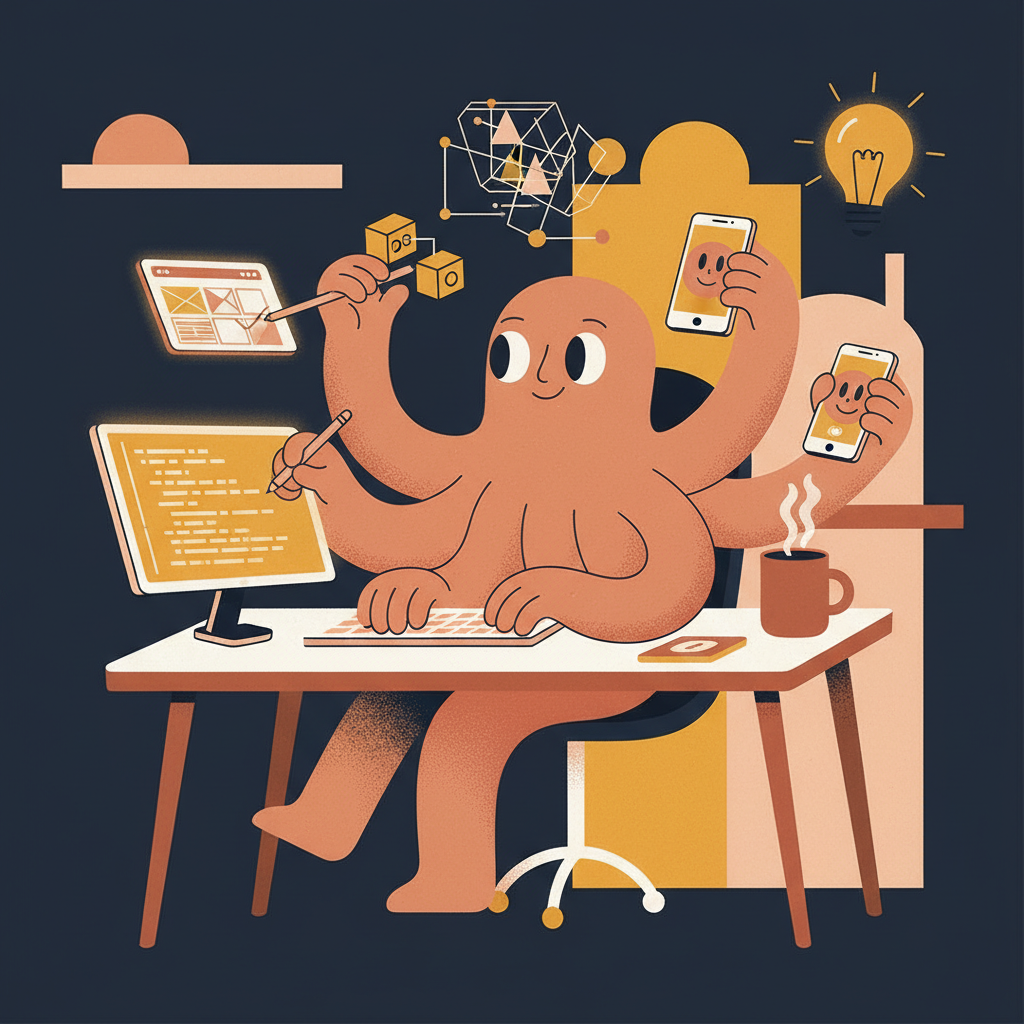
The math on headcount is broken. Your team is 5 people and your roadmap demands 50. Hiring takes 3 months per role, onboarding burns another 2, and by the time someone is productive you've lost half a year of runway. That is insanity.
Picture this. Your roadmap is 50-people big. Your team is 5 people deep. And by Friday, the first three workstreams that have been languishing for months are actually moving - not because you cloned yourself, not because you found a recruiter who can hire in 3 days, but because each of those workstreams now has an AI peer that knows your context, your standards, and your customers as well as any senior hire you'd dream of bringing on. The hiring math you've been losing for two years just inverted. Same burn rate. 3x the throughput. And every week that passes, the system gets sharper.
Here's the thing. When your AI has your knowledge base, your taste docs, and your domain constraints -- it stops being a tool and starts being an extension of you. Not a replacement. Not an outsourced brain. A capital-efficient team member that you direct, that carries your judgment, and that compounds output at 3am while producing work grounded in your specific situation. The value is the triad: you, your knowledge store, and AI working together. This is not incremental. This is a step-function change in the economics of building.
┌─────────────────────────────────────────────────────────────────────────────────┐
│ │
│ ● YOUR INTENT ● AGENT SWARM │
│ │
│ "Pull our persona research Loading knowledge base context ██░ 85% │
│ and KPI targets, spawn Spawning research agent ██░ 70% │
│ agents to draft the Spawning design agents (3) ██░ 55% │
│ product brief from Spawning architecture agent ██░ 65% │
│ first principles." │
│ ⊙ Agents complete - artifacts ready │
│ │
│ ─ ─ ─ ─ ─ ─ ─ ─ ─ ─ ─ ─ ─ ─ ─ ─ ─ ─ ─ ─ ─ ─ ─ ─ ─ ─ ─ ─ ─ ─ ─ ─ ─ ─ ─ ─ ─ ─ │
│ │
│ ● TRADITIONAL SCALING ● AI PEER SCALING │
│ │
│ Need 50-person output? Need 50-person output? │
│ │
│ Hire 50 people. 5 humans + AI peers: │
│ 3 mo hiring per role. │
│ 1 mo onboarding. ┌──────┐ ┌──────┐ ┌──────┐ │
│ 2 mo ramp-up. │ You │ │Peer 1│ │Peer 2│ │
│ = 6 months to productive. │ │ │ │ │ │ │
│ │ judge│ │resrch│ │draft │ │
│ In a startup, 6 months └──────┘ └──────┘ └──────┘ │
│ is a lifetime. ┌──────┐ ┌──────┐ │
│ │Peer 3│ │Peer 4│ Each peer has │
│ │ │ │ │ your knowledge │
│ │synth │ │review│ base, your taste, │
│ └──────┘ └──────┘ your constraints. │
│ │
│ You: direct + refine. │
│ 5 humans = output of 15. │
│ │
│ ─ ─ ─ ─ ─ ─ ─ ─ ─ ─ ─ ─ ─ ─ ─ ─ ─ ─ ─ ─ ─ ─ ─ ─ ─ ─ ─ ─ ─ ─ ─ ─ ─ ─ ─ ─ ─ ─ │
│ │
│ CAREER IMPACT CAREER IMPACT │
│ 40 items on the list. 40 items on the list. │
│ Do 5. Let 35 rot. Direct agents on all 40. │
│ That's not strategy. Review + refine the output. │
│ That's survival. That's leverage. │
│ │
│ │
│ BUSINESS IMPACT BUSINESS IMPACT │
│ Hire for throughput. Hire for judgment. │
│ Headcount = output. One senior person directing │
│ Linear scaling. 5 AI peers > 5 juniors. │
│ Exponential scaling. │
│ │
│ │
└─────────────────────────────────────────────────────────────────────────────────┘
The 100x Individual
You're a solo founder or a team of one inside a bigger org. 40 items on your plate, one pair of hands. The default play is triage -- do 5, let 35 rot. That's not strategy. That's playing defense with a losing hand.
AI peers flip the economics entirely. Build context for each work domain, deploy agents across the domains you can't touch, and suddenly your throughput curve bends.
A founder we work with runs 12 simultaneous workstreams with multiple AI agents. Not 12 ChatGPT tabs -- 12 distinct value streams, each loaded with context from her knowledge base: competitive research, customer outreach drafts, technical architecture docs, investor materials, product specs. Before she built this system, her calendar was a wall of 30-minute context switches and 11pm catch-up sessions that never actually caught up. Six weeks after flipping the model, the backlog of items "waiting for Monica" simply evaporated - not because she worked harder, but because the stuff that used to need her full attention now needed her 20-minute review.
Do the math on what that means in hard dollars. A competent founder's time is worth at least $300 per hour when you weigh opportunity cost, meetings avoided, and decisions unblocked. Reclaiming 25 hours a week is $7,500 of value, every week, compounding for the life of the company. Over a year that is nearly $400K of recovered capacity. From a system that costs less than a single SaaS subscription. The ROI math isn't close. It is a rout.
Imagine if every item you've ever postponed because "I just don't have the bandwidth" was actually getting attention this week. Not perfect attention. But real progress, grounded in your context, ready for your review when you wake up. What would change about the trajectory of your career in 90 days? That is the question worth sitting with.
How to set up AI peers for multiple workstreams: In Claude, create a separate Project for each work domain - "Product Strategy," "Investor Relations," "Engineering Architecture," "Customer Research." Upload the relevant docs, frameworks, and past work into each Project's knowledge. Now each conversation within that Project starts with full context. For even more power, connect your Notion workspace via MCP so your AI peers pull from live, up-to-date information instead of static uploads. Her job now? Direct, refine, and spend her reclaimed hours on the work that actually differentiates - strategic thinking, customer relationships, the hard product decisions nobody else can make. The assembly layer is automated. But the real win isn't 12x throughput on a single salary - it's having time for deep craft on the things that matter most instead of grinding on the things that don't.
A product manager covering 3 product areas deployed AI peers for each: one monitors competitive moves, one synthesizes user feedback, one drafts briefs from the knowledge base. All 3 areas get equal strategic attention. Nothing rots because the throughput bottleneck disappeared. The ROI on that PM's comp just tripled.
Look -- a product designer who's the only designer on the team uses AI peers loaded with user research, persona docs, UX flows, and design system specs. She focuses on information architecture decisions, UX strategy, and finding the right solution between competing constraints. AI handles research synthesis, flow exploration, competitive UX analysis, and layout variations. A product design team of 1 producing the output of 4. Her taste and judgment compound without burning out.
An engineering lead uses AI peers for code review prep, test generation, documentation, and refactoring plans -- all grounded in the team's architecture docs and coding standards. Review cycles dropped from 2 days to 4 hours. Test coverage doubled. Documentation stays current. That's capital deployed against maintenance drag.
A marketing lead at an early-stage B2B startup runs 4 AI peers in parallel: one drafting LinkedIn thought leadership from her interview transcripts, one running SEO keyword analysis against the knowledge base of past posts, one producing email sequences tuned to each persona, and one monitoring competitor positioning shifts week over week. The output that used to require a content manager, a copywriter, and a demand gen analyst - three headcount lines she could never justify - now flows from one operator with a well-tuned knowledge store. The entire content engine on one salary. The agency retainer she was considering? Cancelled before it started.
A sales leader deploys AI peers for deal research, call prep briefs, follow-up drafts, and CRM hygiene. Each peer draws from the company's competitive battle cards, customer success stories, and objection-handling playbooks. Before every call, a full brief lands in her inbox: the buyer's recent LinkedIn activity, the company's last funding round, the three questions most likely to come up based on their persona, and the two case studies to reference. The prep work that used to eat an hour per call now takes 5 minutes of review. Her close rate went up. Her stress level went down. That's the unlock.
Picture this. It's Friday afternoon. Normally you'd be staring at a backlog that quietly haunted your weekend. Instead, your AI peers have been working alongside you all week, and the things that usually rotted are actually shipping. What do you do with that mental space? That's the real prize. Not the throughput. The freedom to think again.
A clinical coordinator uses AI peers to handle intake assembly, scheduling, and routine communications. She focuses on complex clinical decisions and relationship-sensitive interactions -- the work where human judgment is irreplaceable and underwriting risk requires a real brain.
The punchline is the triad: you, your knowledge, and your AI working as one system. An AI peer with access to your customer research, technical constraints, and taste docs produces work you'd actually ship - because it's building with you, not for you. An AI peer with no context produces noise. Full stop. You're not outsourcing your differentiators to AI. You're empowering your agents with everything you've earned - and staying in the driver's seat. The knowledge base is what turns a tool into a teammate. Your judgment is what keeps the teammate accountable.
Think about it like this. The best executives in the world don't write every email, draft every memo, or pull every report. They have chiefs of staff who know how they think, which stakeholders matter, what context applies to which decision. That's the role AI peers now play for everyone - except you don't need a $250K salary line item to access it. You just need to teach the system how you think. One weekend of articulation buys you the chief-of-staff function for life. The companies that figure this out first end up with founders operating like CEOs of organizations 10x their headcount, and ICs operating like senior leaders. That's the new game.
The 100x Team & Business
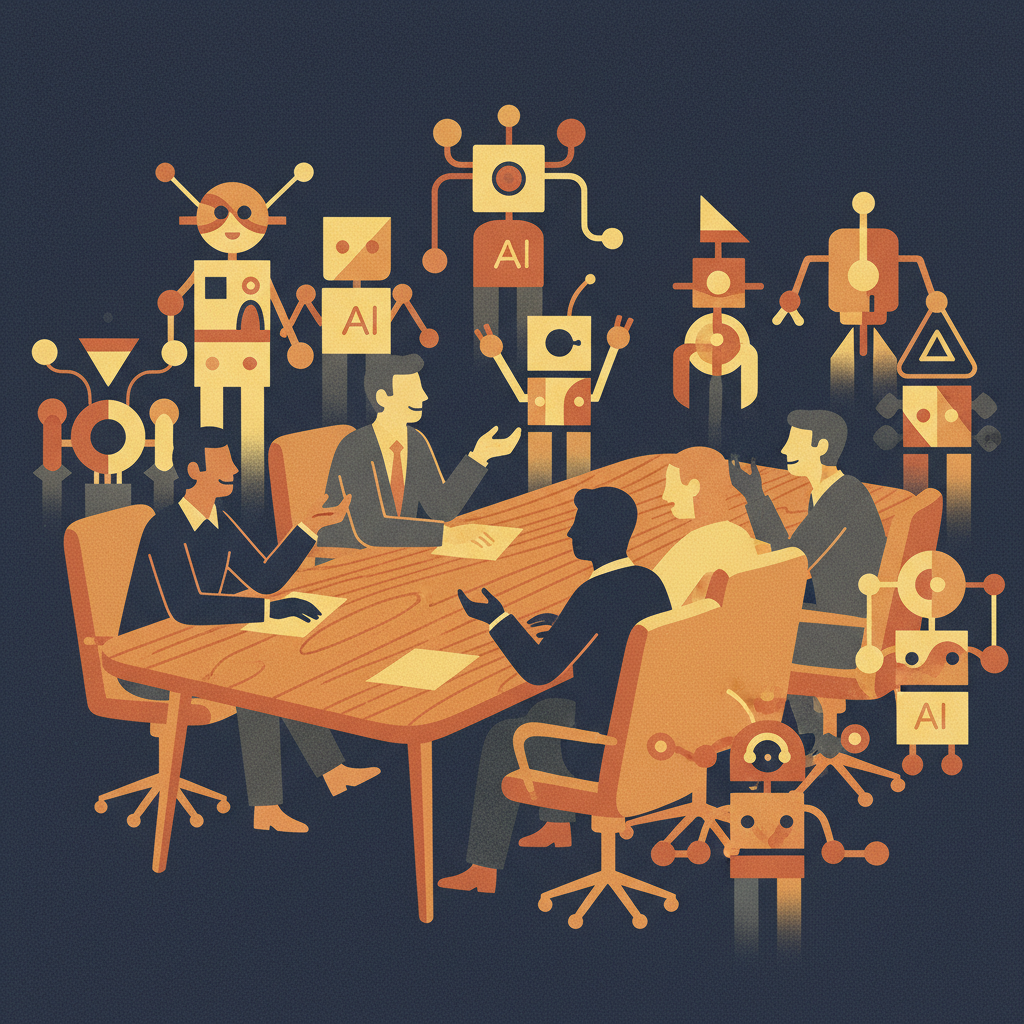
At the team level, AI peers fundamentally rewire headcount economics. The implications for capital efficiency are massive.
The traditional scaling model is linear and brutal. More work requires more people. Each person costs 3 months to hire, 1 month to onboard, 2 months to ramp. Six months from "we need help" to "help is productive." In a startup burning $200K/month, that's $1.2M before you see a single deliverable. That is insanity.
What's stopping you from rewiring this today? Not next quarter. Not after the next funding round. The tools exist. The patterns exist. The only thing standing between your team and a 3x output curve is the assumption that headcount equals throughput. Drop that assumption and the whole game changes.
The AI peer model breaks the linear curve. Each human team member operates with 2-5 AI peers handling context-heavy work in their domain. A product team of 4 humans plus their AI peers produces the output of 15 -- because humans deploy judgment and decisions while AI handles research, synthesis, drafting, and assembly. Same burn rate, 3x the throughput. That's a fundraising story.
One company runs their entire customer operations with 3 human team members and a fleet of AI agents. Each agent has the customer knowledge base, care protocols, and communication standards loaded. The ops team handles complex cases and relationship decisions. The clinical leads handle quality review. AI handles intake assembly, routine communication drafts, data synthesis, scheduling coordination. Three salaries doing the work of ten.
Run the unit economics on that. Seven avoided hires at a blended loaded cost of $120K each is $840K a year recycled straight into product development, market expansion, or runway extension. For a Series A company, that's the difference between raising on favorable terms 12 months from now and raising on dilutive ones next quarter. For a bootstrapped business, that's the difference between profitability and another year of founder salary sacrifice. This is not a productivity story. It is a balance sheet story.
How to structure the human-AI review loop: For each AI peer output, build a simple routing step. In Notion, create a "Review Queue" database where AI-generated drafts land with a status of "Needs Review" and a field for the assigned reviewer - PM reviews strategy, designer reviews UX, engineer reviews code, clinical lead reviews care content. The reviewer spends 15-20 minutes refining, marks it "Approved," and it moves to the next step. Zapier or Notion automations can handle the routing.
Here's the thing -- AI peers are not autonomous. Every output routes to a human for review. The roughly 20 minutes of refinement per task is built into the workflow, not treated as overhead. The PM reviews strategy output. The product designer reviews UX and design output. The engineer reviews code output. The clinical lead reviews care-related output. The human's job shifts from "do the work" to "direct and refine the work" -- which is a dramatically higher-ROI use of their time and expertise. Like a poker player who stops grinding low-stakes tables and starts picking better games.
Net-net -- the hiring implication is enormous. You hire for judgment, taste, and domain expertise. Not for throughput. One senior founder directing 5 AI peers outproduces 5 junior people working independently. One clinical leader with AI peers manages the patient load of 3 coordinators. The bottleneck moves from "not enough hands" to "not enough judgment." And when you solve that bottleneck, something else happens: your best people finally have time for the deep thinking, deep craft, and hardest most interesting problems that have been permanently deprioritized. They're not just producing more - they're doing the work that actually makes a difference because the grind is handled. Time to decision, faster. Time to idea, faster. Time for the work only senior judgment can do? Unlocked. Your headcount math changes permanently. Your cost per unit of output drops by 60-70%. And your team's quality of work goes up because they have space to think.
Where This Applies
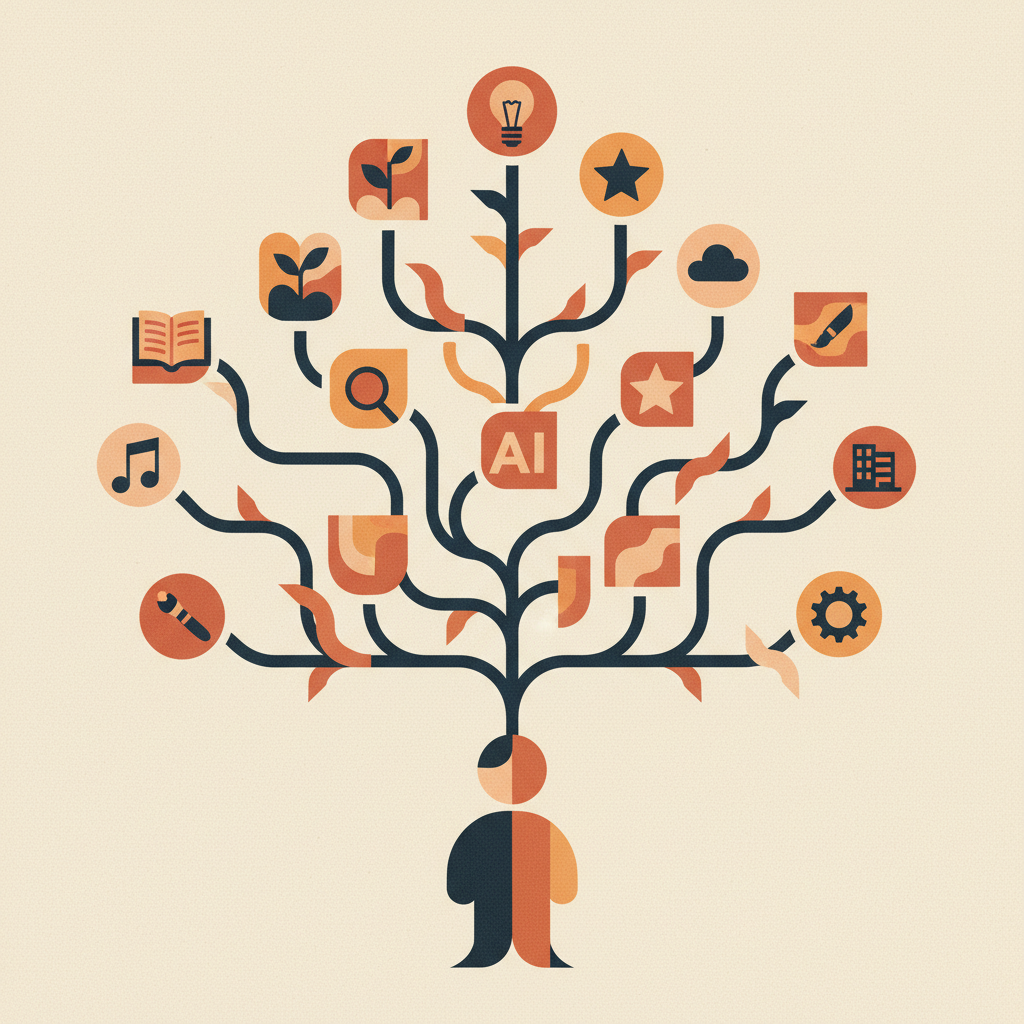
A product design team of 2 produces the output of 8 by running AI peers through their user research, UX flows, design system, and product strategy docs. Product designers focus on information architecture, UX decisions, and finding elegant solutions between constraints. AI handles research synthesis, flow exploration, competitive analysis, and design variations. Two salaries, eight salaries of output. The margin on that is extraordinary.
An engineering lead uses AI peers for code review prep, test generation, documentation, and refactoring plans. Review cycles dropped from days to hours. The team ships more because they maintain less. Velocity compounds.
A clinical operations team of 3 manages a patient load that traditionally requires 10 coordinators. AI peers handle intake, scheduling, routine communications. Humans handle complex clinical decisions and relationship-sensitive interactions. 70% reduction in headcount cost for the same care capacity.
A product manager covers 3 product areas at the quality of covering 1. Research synthesis, brief drafting, competitive monitoring -- all running in parallel. One PM deploying the strategic bandwidth of three.
A founder runs 12 simultaneous projects without coordination overhead. Each workstream has its own context. She reviews and refines. The coordination tax -- which kills most multi-project leaders -- drops to near zero.
A content-led solopreneur running a newsletter with 40,000 subscribers replaced her entire production team with AI peers grounded in her archive of 300+ past essays, her brand voice doc, and her audience research. Research synthesis, outline drafting, first-pass editing, repurposing across Twitter and LinkedIn, and email subject line testing - all handled by peers that know her voice better than any junior writer she could afford to hire. Her newsletter shipping frequency doubled. Her revenue tripled. Her team headcount: still one.
A head of RevOps at a mid-stage SaaS company runs AI peers against the CRM, product usage data, and customer health signals. One peer flags churn risk across the account base daily. Another drafts account expansion plays for the top 20 growth candidates. A third synthesizes weekly board metrics from six different systems. The work that used to require a RevOps analyst hire in the budget plan was absorbed by one operator with a good knowledge base and 4 peer configurations. The headcount ask got pulled from the plan entirely.
Think about it like this. Every senior person you know is bottlenecked by the same thing: not enough hands to execute the ideas in their head. The best operators in your industry aren't smarter than you. They've just stopped accepting that bottleneck as fixed. The gap between you and them is one architectural decision.
The pattern: AI peers multiplied by your context, directed by your judgment, equals scaled output. AI peers multiplied by nothing equals scaled noise. The unit economics work because of all three - you, your knowledge store, and AI. Not one without the others. You're not handing the playbook to a stranger. You're running your own plays through more players. Like a sports franchise - the talent matters, the scouting system and playbook compound over time, but the coach's judgment is what turns all of it into wins.
Examples How Others Have Made This Real
These aren't hypotheticals. Real builders and teams are deploying AI peers loaded with context right now - and the economics are already visible.
Klarna replaced the equivalent of 700 full-time customer service agents with AI peers grounded in their product knowledge, policies, and tone guidelines. Not generic chatbots - context-loaded agents that handle inquiries with the same resolution quality as human agents. Same team size. Radically different output.
Devin by Cognition - the first AI software engineering peer that carries full codebase context, runs in its own environment, and executes multi-step engineering tasks. Engineering leads assign it work the way they'd assign a junior: with context, constraints, and review checkpoints. One senior engineer directing Devin produces the output of a small team.
Claude Code operates as an engineering peer, not an autocomplete engine. It reads your repo, understands your architecture, follows your conventions, and executes multi-file changes with judgment. Engineers treat it as a pair programmer loaded with the team's full context - because it is.
Harvey AI built legal AI peers for law firms - agents loaded with case law, firm-specific precedent, and practice area expertise. Junior associates direct Harvey the way a senior would direct them. One lawyer with Harvey produces the research output of a team of three. The knowledge base is the multiplier.
Intercom's Fin handles 50%+ of customer conversations by drawing from the company's entire help center, product docs, and conversation history. Not canned responses - contextual answers grounded in everything the company knows. Three support agents with Fin do the work of ten.
Replit Agent lets solo founders describe what they want to build, and the agent writes, deploys, and iterates on full applications. Founders running 12 simultaneous workstreams aren't exaggerating - the agent handles the execution layer while the human directs strategy and product decisions.
Zapier + Claude - operations teams build AI peer workflows where agents monitor data sources, synthesize reports, draft communications, and route exceptions to humans. One ops leader with five Zapier-powered AI peers covers the coordination work of a team, directing and refining rather than assembling.
Ask Yourself
These questions reveal whether your AI is an assistant you prompt -- or a peer that carries your context.
How many workstreams are you neglecting because you're one person? List everything on your plate. Now circle the ones that only get attention in crisis mode. Those are the domains where an AI peer -- grounded in your knowledge base -- could be running research, synthesis, and drafts while you sleep. See how agents scale your output →
Does your AI have enough context to produce work you'd actually use? Try this: give AI a real task from your backlog with zero extra context. Is the output usable -- or garbage? The gap between those two is the context gap. Your knowledge base is what closes it. See how the knowledge moat works →
What's the review loop on your AI output? If you're spending 20 minutes refining each AI output -- that's the quality layer working correctly. If you're spending 2 hours rewriting from scratch -- the AI doesn't have your context. One is collaboration. The other is wasted time.
Are your AI peers coworking with your team -- or isolated in separate tabs? Can the PM's AI peer see what the product designer's AI peer produced? Can the engineer's AI peer reference the product brief? If every AI peer starts from zero, you have tools -- not team members. Explore how collaborative spaces connect them →
What are you hiring for -- throughput or judgment? If you're hiring junior people to do volume work, AI peers already do that better. The leverage hire is someone with taste, judgment, and domain expertise who can direct 5 AI peers. That's the 10x math.
What would your team look like with 2-5 AI peers per person? Not theoretically -- specifically. Which domains would each peer handle? What context would they need? What review process would keep quality high? If you can't answer this, you haven't designed the system yet. See the full framework →