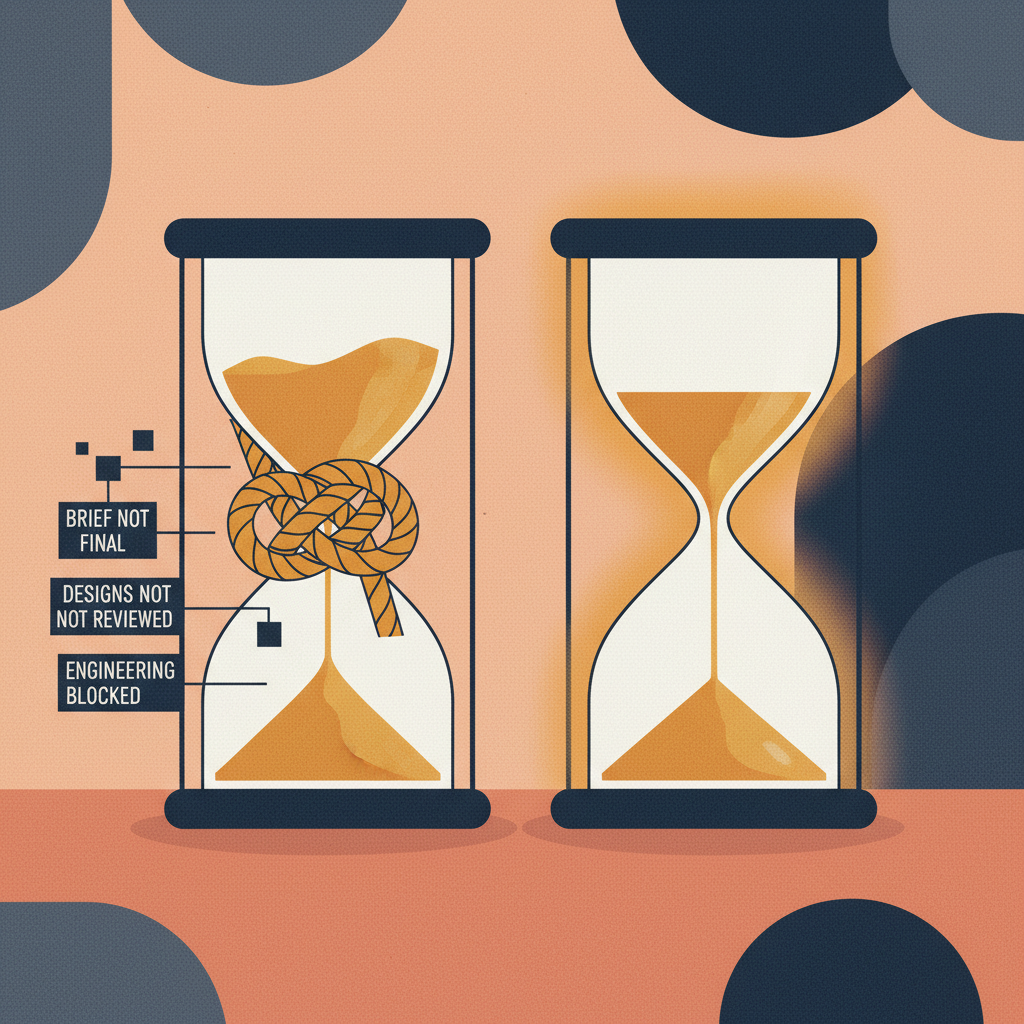
Your competitor just shipped the feature you've been "planning" for three months. You haven't written a line of code because the brief isn't final, designs haven't been reviewed, and engineering is blocked on specs. This is not technical debt. It's decision debt -- and every week it compounds, you're burning capital on learning you will never get back.
Picture this. A competitor in your space ships an experiment Monday, gets real user data by Wednesday, ships a refined version Friday, and learns more in five days than you'll learn this quarter. They're not smarter. They didn't hire better engineers. They built a system where context flows automatically and decisions don't wait. By the time your team finishes the planning meeting, they've shipped, learned, iterated, and started the next experiment. That gap is not closing. It's widening every single week.
Here's the thing: the teams shipping in weeks instead of quarters didn't hire faster. They eliminated the dead time between decisions. That's the entire alpha. And here's what nobody talks about: the speed isn't just about shipping more. It's about unlocking time for deep thinking, deep craft, and the hardest most interesting problems. Every day you spend assembling context instead of deploying decisions is a day you're grinding on work that doesn't differentiate - while your competitor compounds insight and has time left over to think about what to build next.
Run the math on what dead time actually costs. Your senior engineer makes $200k plus burden. Two hours a day of context assembly is $50k a year of her time flushed into overhead. Multiply that across a 10-person team and you're burning half a million annually on work that AI should handle in the background. That's a full additional senior hire you could fund just by eliminating assembly. Now compound that across 3 years and the number gets genuinely obscene. The teams shipping fastest aren't just moving faster - they're running with half-a-million-dollar annual bonuses in the form of reclaimed judgment time. That's not a productivity story. That's a balance sheet story with a clear winner and loser in every market.
┌─────────────────────────────────────────────────────────────────────────────────┐
│ │
│ ● HOW MOST TEAMS SHIP ● HOW A 100x TEAM SHIPS │
│ │
│ Idea ──→ Brief ──→ Design ──→ Build ──→ Ship │
│ wait wait wait wait │
│ 2wk 1wk 1wk 1wk = 6 weeks │
│ │
│ Each "wait" = context assembly + handoff loss │
│ │
│ ┌──────────────────────┐ ┌──────────────────────┐ │
│ │ YOUR DAY │ │ YOUR DAY │ │
│ │ │ │ │ │
│ │ 70%│ │ 30% assembly │ │
│ │ Assembly: pulling │ │ AI handles overnight│ │
│ │ dashboards, reading │ │ │ │
│ │ Slack, gathering │ │ 70%│ │
│ │ context │ │ Judgment: decisions,│ │
│ │ │ │ strategy, shipping │ │
│ │ 30% │ │ │ │
│ │ Judgment: actual │ │ Context flows across│ │
│ │ decisions │ │ every handoff. No one│ │
│ │ │ │ re-establishes what │ │
│ └──────────────────────┘ │ the last person knew.│ │
│ └──────────────────────┘ │
│ Idea to prod: 6 weeks │
│ Idea to prod: 8 days │
│ │
│ ─ ─ ─ ─ ─ ─ ─ ─ ─ ─ ─ ─ ─ ─ ─ ─ ─ ─ ─ ─ ─ ─ ─ ─ ─ ─ ─ ─ ─ ─ ─ ─ ─ ─ ─ ─ ─ ─ │
│ │
│ CAREER IMPACT CAREER IMPACT │
│ Your competitor shipped it You shipped it. You learned │
│ while you were still from real users. You iterated. │
│ assembling the brief. 3 cycles while they did 1. │
│ │
│ │
│ BUSINESS IMPACT BUSINESS IMPACT │
│ 3 experiments per quarter. 12 experiments per quarter. │
│ Slow learning. Competitors 4x faster learning. Speed │
│ catch up. advantage compounds. │
│ │
│ │
└─────────────────────────────────────────────────────────────────────────────────┘
The 100x Individual
Track your day honestly. How much time do you spend deploying judgment versus assembling the context to deploy it? For most builders the ratio is brutal -- 70% assembly, 30% actual decisions. You're spending the supermajority of your highest-value hours on work AI should handle overnight. That is insanity.
Look -- this is what it looks like across roles when you fix the ratio.
A product manager measured the bleed. Monday morning: 45 minutes pulling sprint data from three dashboards, 20 minutes re-reading Slack threads, 30 minutes mining customer feedback. He hadn't made a single decision and the morning was gone. Sound familiar? That's not work. That's overhead masquerading as work.
He restructured. AI now assembles a pre-sprint brief overnight -- pulling data, surfacing trends, mapping feedback to roadmap items. He walks in Monday with context that used to take until lunch.
How to build your Monday morning pre-brief: Set up a Zapier flow that runs Sunday night: (1) pull unresolved Slack threads from your product channel, (2) pull new customer feedback from your CRM or Intercom, (3) pull sprint board status from Linear or Jira. Feed all three into a Claude API call with the prompt "Synthesize this into a 1-page sprint context brief: key customer signals, blockers, and decisions needed." Output lands in a Notion page titled "Sprint Brief - [Date]." You walk in Monday morning holding cards nobody else has seen. Sprint planning starts at 9am instead of 2pm. That's a half-day reclaimed every single week - not just for shipping more, but for the deep product thinking that actually moves the needle. He uses that time to sit with customer problems, pressure-test strategy, and think about what his team should build next quarter. Over a year that's six extra weeks of the highest-leverage work a PM can do. The IRR on that investment is absurd.
A product designer applied the same principle. Instead of burning 2 hours researching patterns before touching a canvas, she built a context package -- her design system, user research synthesis, competitor UX patterns tagged by flow type, and accessibility requirements. She prompts with constraints and starts from a meaningful first draft. Time to first reviewable design solution dropped from 2 days to 3 hours. But the real win isn't the speed - it's what she does with the time back. She now explores 5 directions in the time it used to take to develop 1, then spends the reclaimed hours on the deep craft work that actually differentiates her product: information architecture decisions, interaction nuance, the hard UX problems nobody else has time to think about. Like a poker player seeing five flops instead of one -- the information advantage compounds fast.
Imagine if every meeting you walked into had full context already loaded, every stakeholder had the same briefing, and the first 15 minutes were spent debating the decision instead of re-explaining the situation. That's what kills most organizations: the meeting before the meeting before the meeting, each one burning 4 calendars to re-establish what everyone already figured out last week. Eliminate the re-establishment tax and your calendar opens up by 30% overnight. Not because you work less - because you stop paying the same context rent over and over. The builders who move the fastest have no idea they're in an arbitrage. They just wonder why everyone else is so slow.
How to eliminate handoff context loss: Create a single "Feature Context" Notion page (or Linear project doc) for each feature. Every stage writes to it: PM adds the brief, designer adds the rationale and UX flows, engineer adds the technical approach and constraints. Connect the Notion workspace to Claude via MCP. Now when the engineer starts building, they ask Claude "What was the design rationale for this feature?" and get the designer's actual thinking - not a Slack summary from 3 weeks ago. One living doc per feature. Zero context death at handoffs.
An engineering lead eliminated handoff gaps. Each step's AI has access to every previous step's output plus the shared knowledge base. Specs include design rationale. Designs include engineering constraints. PRs include business context. Nobody spends a day re-establishing what the last person already figured out. Cycle time compressed from 6 weeks to 8 days. Full stop.
A clinical operations leader deployed a new care workflow in 48 hours instead of the typical 8-week IT project. The orchestration hub handled routing, the knowledge base provided protocols, AI assembled the config. Humans reviewed and approved. Done. That's what shipping looks like when you stop burning capital on dead time. And here's the part her board couldn't believe: the 48-hour version had fewer defects than the typical 8-week version, because the human review time went into catching actual problems instead of re-reading the same documentation three times. Speed didn't trade off against quality - it bought more of it, because the reviewers were finally looking at the version that mattered.
A founder went from idea to live patient portal in 2.5 weeks -- work that traditionally takes 6 months. AI-assembled context at every stage. Zero dead time between stages. That's not superhuman effort. That's architecture derisking the time-value-of-shipping.
What's stopping you from rebuilding your week around this principle starting Monday? Not headcount - the slowest teams I see are often the largest. Not budget - the cheapest interventions have the highest ROI. The blocker is the comfort of the meeting cadence you've always run, the standup structure you inherited from a previous job, the assumption that "this is just how long things take here." It isn't. It's how long things take when assembly is manual. Automate the assembly and the timeline collapses. The team that breaks the comfort first wins the next 18 months.
The principle: eliminate every minute you spend on assembly so you can invest every minute in judgment, craft, and the work that actually makes a difference. Every handoff you automate, every context package you build, every workflow you orchestrate -- each one removes dead time and gives you back hours for deep thinking, deep craft, and the hardest most interesting problems in your domain. The value is the triad: you directing the work, your knowledge store carrying the context, and AI extending your capacity. You're not outsourcing the building to AI. You're empowering agents to handle the grind so you can focus on the decisions, the creative leaps, and the strategic depth that actually move the needle. Net-net, the builder who ships 4x faster doesn't just win on speed. They win on insight - and they win on depth, because they have time to think about what really matters instead of grinding on what doesn't.
The 100x Team & Business

At the team level, speed to market is a systems problem. Not a people problem. Your team is talented. They're slow because the system between them is slow -- and that system is burning capital every single day it stays broken.
Map any feature from idea to production. Count the handoffs. Product writes a brief, waits for design review. Design produces mockups, waits for engineering review. Engineering builds, waits for QA. QA tests, waits for deploy. Each "waits for" is dead time. Each handoff loses context. By the time the feature ships, it's been touched by 6 people and none of them had the full picture at any point. That is insanity.
The AI-native approach compresses this. AI maintains the full context across every handoff. The brief includes engineering constraints because the AI pulled them from the architecture docs. The design includes accessibility requirements because the AI referenced the component library. The engineering spec includes business context because the AI surfaced the customer evidence. The clinical context flows automatically into every care-related decision. Nobody waits for information that already exists.
One team cut their idea-to-production cycle from 6 weeks to 8 days. Not by working more hours. By eliminating context loss at handoffs. The PM's brief flows into design with full context. Design flows into engineering with full context. Ops gets the deployment context. No one re-establishes what the last person already figured out.
Think about the second-order effects of that compression. When the cycle is 8 days, you can afford to run an experiment for a feature you're only 60% confident about. When the cycle is 6 weeks, you can only afford to run experiments you're 95% confident about. Slow cycles force conservatism - you bet only on the sure things. Fast cycles allow curiosity - you bet on the interesting things. Guess which strategy produces more breakthroughs. The fast team isn't just shipping more. They're shipping fundamentally different bets because the cost of being wrong collapsed. That's how companies end up with the weird, contrarian, category-defining product and their competitors end up with the safe, obvious, forgettable one. The speed isn't the strategy. The speed is what makes the better strategy affordable.
The punchline is the compounding effect - and it's two-sided. Think of it like two investment portfolios. A team shipping weekly runs 12 experiments per quarter. A team shipping monthly runs 3. Same talent, same market, same capital -- but a 4x difference in learning velocity. After one quarter the fast team has 12 data points to the slow team's 3. After a year? 48 versus 12. But here's the part people miss: the fast team also has more time between shipments for deep thinking, strategic planning, and the craft work that makes those 48 experiments better than their competitor's 12. They're not just grinding faster - they're thinking deeper because the grind is automated. Time to decision, faster. Time to market, faster. Time to idea, faster. And time for the hardest, most interesting problems that actually differentiate? Unlocked. Speed is the moat - but depth is what the speed buys you.
Think about it like this. A startup that ships weekly is running the same experimental cadence as a top-tier hedge fund running daily portfolio rebalancing. Fast feedback loops, real-money outcomes, immediate course correction. The slow team is running the cadence of a 1990s mutual fund: quarterly reviews, stale data, decisions by committee. Both are "doing the work." Only one is actually compounding. The format you choose determines the asset class you're operating in - and the returns scale accordingly.
Where This Applies
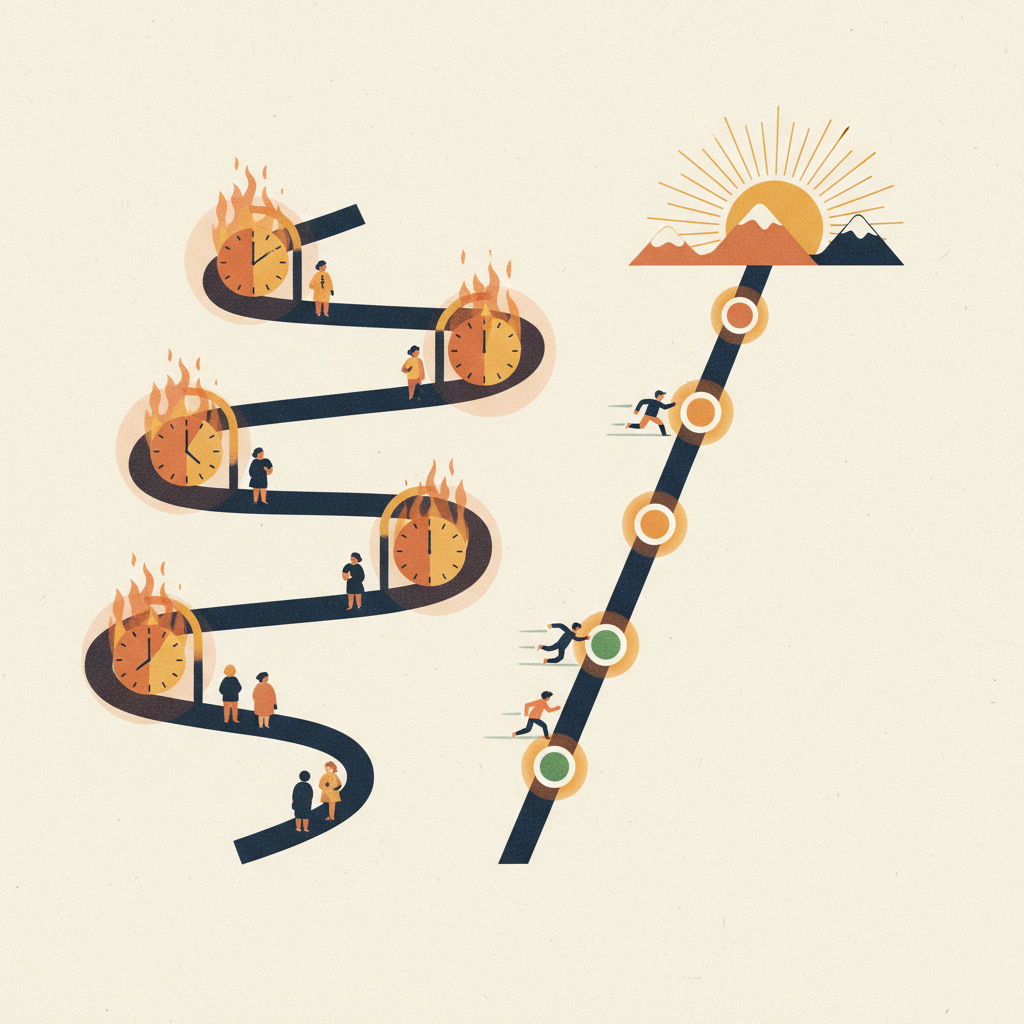
A startup founder went from idea to live patient portal in 2.5 weeks. Not superhuman effort -- AI-assembled context at every step. User research synthesized into requirements, requirements flowing into design specs, design specs flowing into component architecture. Zero dead time. Like a quarterback getting the snap and throwing in one motion instead of holding the ball for five seconds while the pocket collapses.
A marketing team cut campaign launch from 3 weeks to 4 days. Brief assembly, creative direction, copy drafting, and channel configuration all draw from the same knowledge base. Each step starts pre-loaded with context from the previous step. That's 3 weeks of learning they would have missed.
A clinical operations team deployed a new care workflow in 48 hours instead of 8 weeks. Hub handled routing. Knowledge base provided protocols. AI assembled the config. Humans reviewed and approved. The old timeline was not a complexity problem. It was a dead-time problem.
A product manager reclaimed a half-day every week. Sprint velocity increased not because the team worked harder, but because decisions deployed 3x faster. Multiply that across 52 weeks and you've underwritten an entirely different trajectory.
A design engineer generates 5 directions in a morning and presents the strongest 2 with evidence. Quality went up because she tested more hypotheses. Time went down 60%. More reps, better signal -- same principle that makes a pitcher with 200 innings of data more valuable than one with 50.
A biotech operations lead rewrote her team's regulatory documentation workflow from a 12-week grind into a 9-day cycle. Not by cutting corners - regulated industries don't allow corners. By eliminating the dead time between the scientist who knew the data, the writer who could draft the submission, and the reviewer who held the quality bar. Her orchestration hub pulls experiment results, assembles the draft with proper citations, flags compliance gaps against the framework library, and routes the right sections to the right reviewers in parallel. The scientists stopped spending half their time writing. The writers stopped spending half their time asking questions. The reviewers stopped spending half their time re-reading prior drafts. Her submission velocity doubled. Her team's morale tripled. When the FDA auditor visited, he asked how her team was producing this volume with this level of rigor. The answer was simple: nobody was doing the assembly work anymore. They were all doing the judgment work.
Imagine if your team's velocity doubled and the quality of every decision went up at the same time. Imagine if "we should ship more experiments" stopped being a wish and became a Tuesday afternoon. Imagine the strategic conversations you'd be having if context assembly wasn't eating your senior people's calendars. Those conversations are the actual work of leadership. The grind is just what's blocking you from getting there. Eliminate the grind. The leadership work is waiting on the other side.
The pattern: speed comes from eliminating dead time, not from working faster. The team that builds the triad - their people directing, their knowledge store carrying context, and AI extending capacity - ships circles around the team still assembling information by hand. You're not outsourcing speed to AI. You're unlocking it by empowering agents to build with you. 12 experiments versus 3 experiments. That's not a marginal improvement -- that's a different company.
Examples How Others Have Made This Real
These aren't hypotheticals. Real teams are shipping in weeks what used to take quarters - and the speed advantage is already compounding into market position.
Vercel ships product updates at a pace that makes enterprise competitors look frozen. Their team uses AI across every stage - from spec to code to deploy - with shared context flowing through each handoff. The "wait for" gaps that kill most product cycles are near zero. Features go from idea to production in days, not months.
Cursor went from concept to the dominant AI code editor in under a year. The team is tiny relative to output. AI-assisted development with shared context across the team compressed every cycle. They ship weekly updates that competitors with 10x the headcount can't match.
Replit deployed a full AI agent product in weeks. CEO Amjad Masad has publicly described building production features in hours using AI tools loaded with product context. The dead time between "idea" and "users touching it" is measured in days, not quarters.
Linear ships product at a velocity that consistently surprises their market. Small team, massive output. Their workflow eliminates context assembly - every handoff from product to design to engineering to deploy carries full context. Sprint planning starts at 9am, not after lunch.
Bolt.new and Lovable - these AI-powered builders let founders go from idea to deployed prototype in hours. Not mockups. Deployed, working applications. The "planning phase" that used to consume 3 months before code was written has been compressed to a conversation. The dead time between decision and deployment - eliminated.
Shopify transformed their shipping velocity by mandating AI usage across engineering. Teams that previously spent days on context assembly now have AI pre-assemble sprint context, flag technical constraints, and surface relevant prior art before anyone opens their editor. The result: features that took 6 weeks now take 8 days.
Y Combinator batch companies (2024-2025) are shipping production applications in 2-4 weeks that would have taken previous batches 3-6 months. The pattern is consistent: AI-assembled context at every stage, zero dead time between stages, shared knowledge bases that eliminate re-establishment. YC partners now explicitly coach founders to "ship this week, not this quarter."
Ask Yourself
These questions will expose exactly where your dead time lives - and whether your speed problems are people problems or architecture problems.
What's your honest assembly-to-judgment ratio? Track one full day. How many hours did you spend gathering context, pulling up dashboards, re-reading threads - vs. actually making decisions? If it's 70/30 assembly, you're doing the hard part by hand. See how orchestration eliminates dead time →
How many handoffs does a feature touch between idea and production? Count them. Now count how many of those handoffs lose context. Every "wait, what was the rationale again?" is dead time that compounds across every feature, every sprint, every quarter.
Does your team start Monday with context - or spend Monday assembling it? If sprint planning doesn't begin until after lunch because everyone needs to catch up, that's half a day of building time evaporated. Every week. Explore how shared knowledge changes the morning →
Can your AI pre-assemble context for your next decision? Not just summarize what happened - surface the data, flag the anomalies, map the patterns, and have it ready before you sit down. If your AI only responds when prompted, you're at Level 1. See what Level 2 looks like →
How fast does your team learn from what it ships? A team shipping weekly runs 12 experiments per quarter. A team shipping monthly runs 3. Speed isn't just about time to market - it's about time to insight. Which pace are you running?
Where's the longest "wait for" in your pipeline? Brief waits for design review. Design waits for engineering review. Engineering waits for QA. Find the longest wait. That's your highest-leverage fix. See the full framework →