
For most of your career, the deal was simple: your value was your output, and your output was capped by how fast you could execute.
Speed was supposed to pay off twice. Every tool that sped up the busy work was sold as a way to give you time back - time to think, to design, to do the work that actually made you good. The spreadsheet ran the numbers so you could find the insight. The design tool rendered the screen so you could shape the idea. The faster framework wrote the boilerplate so you could solve the real problem.
That is not how it went. Each tool that sped the busy work up quietly created more of it. Faster email turned into ten times the messages. Faster spreadsheets turned into more models to build and keep alive. Faster mockups turned into more screens, more variants, more review cycles, a design system to maintain. The busy work never shrank to make room for your best work. It expanded to fill the time the tools handed back, and then took a little more.
So for your whole career, your edge was fighting a rising tide. By the end, the busy work could eat most of your day - 80%, 90%, on a bad week all of it - and the part that was actually you, the judgment and the taste and the hard creative call, got squeezed into the margins: a stolen hour on a good day, fifteen minutes on a bad one. You were good in spite of the grind, not because anyone ever gave you the room for it.
The walls between disciplines were just as fixed. You could see over them; you almost never crossed them. The designer didn't build. The founder couldn't hold the whole business in their head while chasing a single idea. The engineer inherited an architecture full of decisions they had no time to understand and a regulatory landscape they were told to leave to legal. Crossing a line meant years of retraining or headcount you couldn't get, so the lines held and everyone stayed in their lane.
Both of those facts stopped being true at the same time.
The grind is now largely assistable. This isn't a forecast. Erik Brynjolfsson and his co-authors at Stanford and MIT studied 5,179 customer support agents using an AI assistant and found productivity up 14% on average, and up 34% for the newest, least experienced workers - the tool took the tacit know-how of the best agents and handed it to everyone else. Klarna put a number on the ceiling of that idea: in its first month, its assistant handled two-thirds of customer service chats and did the work of 700 full-time agents, cutting resolution time from eleven minutes to under two.
And the walls came down with it. A designer can now think with the assistance of code, prototyping the real thing instead of describing it. A founder can hold every depth of the business in view while testing a single idea - the contracts, the unit economics, the support tickets, the regulatory edge cases, all at once. An engineer finally has the room to understand the regulation they build inside, and the decisions that hardened into the architecture long before they arrived. Work that used to demand a whole other discipline now fits inside an afternoon.
So the grind is going and the lanes are dissolving. Which leaves a question worth sitting with, and answering honestly: what is left, and what will you do with it?
┌──────────────────────────────────────────────────────────────────────┐
│ │
│ THE OLD MOAT │
│ Execution speed. Yesterday: scarce and expensive. │
│ Today: abundant, near-free, copyable in a quarter. │
│ │
│ THE NEW MOAT │
│ Ambition. Yesterday: unexamined, set low, mistaken for fact. │
│ Today: the scarce complement few think to build. │
│ │
│ ─ ─ ─ ─ ─ ─ ─ ─ ─ ─ ─ ─ ─ ─ ─ ─ ─ ─ ─ ─ ─ ─ ─ ─ ─ ─ ─ ─ ─ ─ ─ ─ ─ │
│ │
│ WHERE THE BOTTLENECK MOVED │
│ build AI coworkers ──→ absorb the grind │
│ conceive new ceilings ──→ aim the freed capacity higher │
│ the wall you can't see ──→ the unknown limits, the real prize │
│ │
└──────────────────────────────────────────────────────────────────────┘
Top of Your License Is Necessary. It Is Not the Win.
The cleanest way to name what AI gives back is a phrase borrowed from medicine. Around 2013, nursing leaders started talking about working at the "top of your license," building on a 2010 Institute of Medicine call for nurses to practice "to the full extent of their education and training." The idea is precise: a nurse who spends the day on intake forms and chart hunting is being paid for a license they aren't using. Strip away the non-value-added tasks, and the same person does the high-judgment work they were actually trained for.
That is what assistable execution does for every professional. Hand the grind to AI and you get to operate at the top of your license: your most creative, most strategic, most genuinely interesting work, the part that needed a human all along. A decade of training pointed at the calls that need it instead of the busywork that buried it.
Here is the trap. Reaching the top of your license is necessary, and it is not sufficient. Your peers get the same lift from the same models in the same browser. If all you do with the reclaimed hours is execute more - more decks, more analyses, more screens, faster - you haven't built a moat. You've joined a faster commodity race, and you'll lose it to whoever has cheaper inputs. The freed capacity is the raw material. What you point it at is the entire game.
When Execution Is Abundant, the Bottleneck Moves to Ambition
There's an old economic pattern worth applying here: when one input becomes abundant, value migrates to its scarce complement. When ATMs automated cash handling, the economist James Bessen pointed out, banks didn't fire their tellers. Branches got cheaper to run, so banks opened more of them, and tellers moved up-license into relationship and sales work the machines couldn't touch. The cheap thing got cheaper. The scarce complement got more valuable.
Execution just became the cheap thing. So what's the scarce complement now?
It's the ambition to aim higher - the judgment about which problem is worth solving and the nerve to set a ceiling above the one you have quietly accepted. Eli Goldratt's theory of constraints says a system's throughput is set by its single binding constraint, and the moment you elevate that constraint, a new one appears somewhere else. For a hundred years the binding constraint on knowledge work was execution capacity. We just elevated it. The new constraint isn't your ability to do the work. It's your ability to conceive of work worth doing.

And here is the part worth turning on yourself: are you setting that ceiling high enough? The evidence suggests most of us do not. Edwin Locke and Gary Latham spent thirty-five years proving that specific, difficult goals beat vague "do your best" goals in the overwhelming majority of studies, with the hardest goals driving performance more than 250% above the easiest. But their research carried one boundary condition - performance climbs with difficulty only up to the limit of a person's ability. For your whole career, that ability limit was real, so you learned to set goals just underneath it. AI just moved the limit. It is worth checking whether you are still setting goals against the old wall, aiming at targets that were ambitious in 2022 and are now simply small.
The Limits Worth Hunting
Ambition, made concrete, is the practice of finding and breaking limits. There are four surfaces where they live.
Limits on yourself. The scope you believe is yours, the title you operate inside, the work you assume requires someone more senior. The designer who never touched positioning. The engineer who left architecture to the staff level. These are the easiest to move and the first to fall.
Limits on your team. The org chart, the headcount plan, the reflexive "that would need a whole department." A team that can summon the output of three functions stops being capped by which functions are in the room.
Limits on your discipline. The boundary your entire field treats as the edge of the job, the things "we don't do" because the profession drew its lines decades ago for people who didn't have any of this.
Limits on your outputs. The quality and ambition ceiling of what you actually ship - the difference between a competent deliverable and one that resets what good looks like in your category.
Cut across all four and you find the real division: known limits versus unknown ones. Known limits are the ones you complain about - headcount, budget, time. You can attack those today. The unknown limits are the dangerous, valuable ones: constraints built into your profession so long ago that you've stopped seeing them as choices and started treating them as physics. You can't aim past a wall you don't know is there. That's the highest-value real estate you own, and by definition you can't see it. So the real work is uncomfortable and mostly internal: interrogate the assumptions you have never questioned, the quiet "that's just how it works here" you have stopped hearing yourself say. The limits worth the most are usually the ones you would defend as obviously true. Start your hunt there.
The Two Moves That Win the New Race
The contest now tends to come down to two moves. It is worth asking yourself, honestly, whether you are attempting either.
The first move is building AI-infused coworkers that absorb the grind. Not prompting - building. The gap between asking a chatbot for a draft and standing up an agent loaded with your context, your standards, and your constraints is the gap between a tool and a teammate. This is the augmentation that actually compounds, and it's where the frontier of usage already sits. Anthropic's Economic Index, which tracks how people use Claude at scale, found augmentation - human and AI working in a loop - still outweighing full hands-off automation late into 2025. The win isn't firing yourself. It's cloning the parts of yourself that were holding the rest of you back.
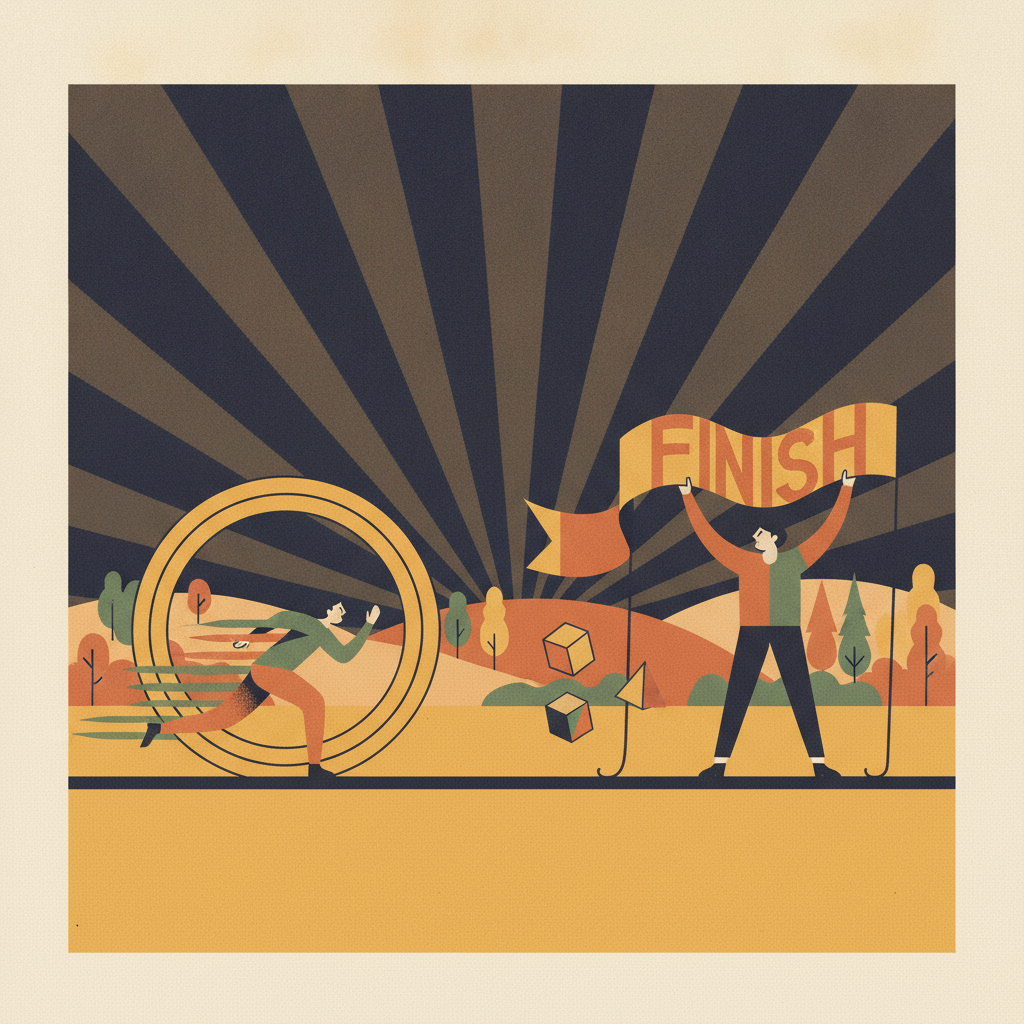
The second move is conceiving new ceilings worth aiming at - and it's worth ten times the first, because it doesn't move you up the existing ladder. It changes where the ladder leads. Look at who's winning. Anysphere, the maker of Cursor, went from zero to two billion dollars in annual recurring revenue in roughly three years, the fastest any software company in history has done it, with a team in the low hundreds and one of the highest revenue-per-employee figures the industry has seen. Midjourney did something similar in images: a few dozen people, no venture capital, hundreds of millions in revenue. Neither won by executing the old job faster. They redrew what the job was - what a code editor could be, what image creation could be - and then built toward a ceiling the incumbents couldn't even see.
That's the tell. The ones pulling ahead aren't the most efficient operators of the existing game. They're the ones who questioned what the game was, and changed it.
Why Ambition Is a Moat
Call something a moat and you're claiming it's both valuable and hard to copy. Ambition clears both bars in a way execution no longer can.
Capability is commoditized. Your competitor has the same models you do, available this afternoon, for twenty dollars a month. Execution speed is now table stakes - copyable in a quarter, leasable by anyone. None of that is defensible.
Ambition is defensible precisely because it's scarce, and it's scarce for reasons that won't resolve quickly. It's psychologically suppressed: people default to conservative goals, the "do your best" setting Locke and Latham found produces middling results. It's trained out of you by old constraints that taught your imagination to stop generating desires it couldn't fund. And it's uncomfortable, because aiming at a ceiling you're not sure you can reach means risking a visible miss. Klarna's own story shows the discipline it takes - after the triumphant automation numbers, they walked some of it back in 2025 and reintroduced human judgment for the hard cases. Pure execution hit a ceiling. The judgment layer reasserted itself, because that was the part that was actually scarce.
Most of all, ambition compounds. Every ceiling you break reveals the next one. Every AI coworker you build frees capacity to aim higher still. That's a flywheel, and it's powered by your specific judgment about where to point it - which is the one input a competitor can't purchase. You can buy the models. You cannot buy the willingness and the imagination to aim them at a bigger target.
The Stakes
This is starting to sort people and companies.
The best roles will go to the operators who set the ceiling, not the ones who hit the existing one a little faster. The best teams will form around the people redrawing the board, because that's where the interesting work and the leverage now live. And the companies that pull ahead won't be the ones who ran the old playbook most efficiently. They'll be the ones who looked at a constraint they had treated as permanent, recognized it was load-bearing only out of habit, and walked through it before a competitor thought to ask the same question.
Your execution was never going to be your moat for much longer. It's a rented advantage now, and the rent is falling toward zero. The one thing that stays scarce - the one thing that compounds, that can't be bought, that separates the operator who resets a category from the one optimizing a job that's quietly shrinking - is your ambition. The capacity to find the wall you mistook for physics, and aim past it.
So change the question you start with. For two centuries it was "what can I do faster?" - and that one is now answered, cheaply. The more useful question is harder, because it points inward: "what have I been treating as fixed that no longer is?" You won't find those limits by studying the competition. You find them by auditing your own assumptions, especially the ones you would swear are just reality. Pick one this week. Test whether it is still true. Then aim past it, and put your AI coworkers to work building toward whatever you find on the other side.
Ask Yourself
These questions are built to surface the limits you've stopped seeing - the ones you would defend as obviously true.
When you freed up time with AI, did you fill it with more execution or with bigger problems? More decks faster is the commodity race. The reclaimed hours are raw material, not a finish line. See why elevation beats automation →
What's the most ambitious goal you'd set if you knew execution was free? Write it down. Then check how much of what made it feel impossible just stopped being true.
Where are you still operating below the top of your license? Name the work only you can do, then name the busywork still crowding it out. See how to set the new performance bar →
Have you built an AI coworker, or are you still just prompting a chatbot? The difference between a tool and a teammate is whether it carries your context, your standards, and your constraints.
What does your discipline treat as "not our job" that no longer has to be? Those are the lines your field drew before any of this existed. Many of them are now optional.
If you turned your edge into something the company owns, would it compound? Individual ambition is a moat. Institutionalized ambition is a bigger one. See how to turn a personal edge into a company asset →