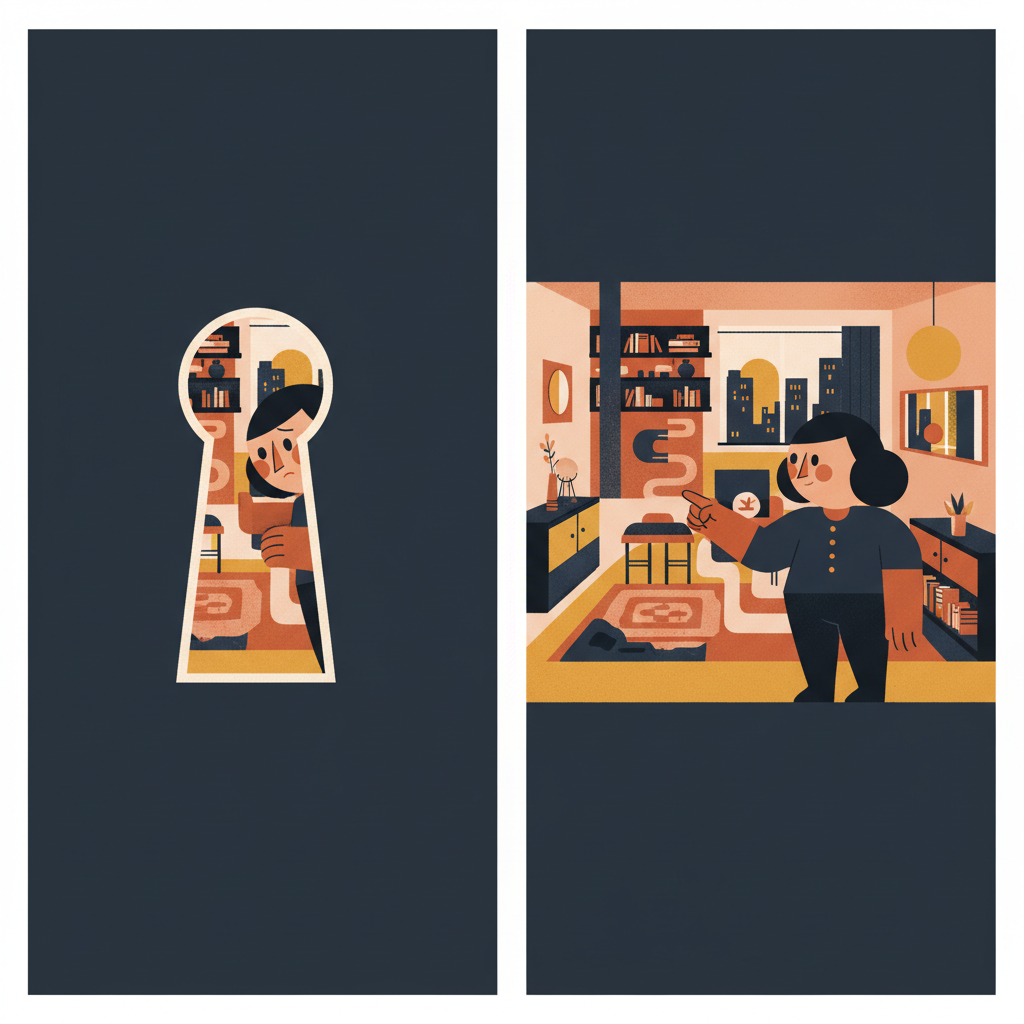
You are making every decision through a keyhole. And you don't even know it.
Think about the last high-stakes call you made - a product bet, a positioning decision, a hire, an architecture choice. How many perspectives did you actually consult? Your own experience. Maybe a colleague or two. An article you half-remember. The instinct you've built over your career. That's it. That's the full input set for a decision that might shape the next 18 months of your business.
Now think about what you didn't consult. The behavioral psychology research on why users actually abandon checkout flows. The pricing theory that explains why your competitor's packaging works and yours doesn't. The failure patterns from an adjacent industry that map exactly onto your current architecture risk. The 200 customer calls sitting in your CRM where customers told you exactly what they needed - but you only remember the last 5.
Think about it like a poker player who only looks at their own cards. They might be skilled at reading their own hand, playing position, managing the pot. But they're ignoring the community cards, the bet sizing, the table texture, the tells from the other players. They're optimizing a tiny slice of the decision space and calling it strategy. That is every knowledge worker making calls from memory alone. Decent cards played in the dark. Winnable hands lost because the information was sitting right there on the felt.
You had access to all of it. You just couldn't hold it all in your head at once. That limitation is gone.
Every professional has what I call a personal context window - the number of perspectives, knowledge domains, and data sources you can actively synthesize when making a decision. For your entire career, that window was brutally small. Limited by working memory, by time, by the simple fact that a human brain can only hold so many threads simultaneously. Your decisions were good. But they were shaped by whatever happened to be top of mind, not by everything that was relevant.
AI didn't just give you a faster typist. It gave you an infinitely wider lens.
Imagine if every decision you made tomorrow was informed by every relevant perspective on the planet. Not just the three colleagues you can text. Not just the article you half-remember. Every framework, every adjacent-industry case study, every research paper that bears on the call you're about to make - synthesized, ready, in the room with you. The narrow keyhole becomes a panoramic window. And the strange thing is, your judgment doesn't change. Your judgment is still the filter. But what your judgment has to filter expands by 100x. What would change about the calls you're making this week if your input set was 100x richer?
┌─────────────────────────────────────────────────────────────────────────────────┐
│ │
│ ● THE NARROW CONTEXT WINDOW ● THE WIDE CONTEXT WINDOW │
│ │
│ WHAT YOU CONSULT: WHAT YOU CONSULT: │
│ │
│ Your Experience ──→ Decision Your Experience ──┐ │
│ 200 customer calls ──┐ │
│ ┌─────────────────────────┐ Behavioral psych ──┐ │ │
│ │ Your 10 years │ Pricing theory ──┐ │ │ │
│ │ 3 colleagues' opinions │ Adjacent markets ─┤ ├──→ Decision │
│ │ An article you recall │ Failure patterns ─┤ │ │ │
│ │ Your gut instinct │ Domain expertise ──┘ │ │ │
│ │ │ Team context ────────┘ │ │
│ │ = 4 inputs │ Historical data ────────┘ │
│ └─────────────────────────┘ │
│ = unlimited inputs, synthesized │
│ │
│ ─ ─ ─ ─ ─ ─ ─ ─ ─ ─ ─ ─ ─ ─ ─ ─ ─ ─ ─ ─ ─ ─ ─ ─ ─ ─ ─ ─ ─ ─ ─ ─ ─ ─ ─ ─ ─ ─ │
│ │
│ DECISION QUALITY DECISION QUALITY │
│ Good instincts, narrow view. Good instincts, panoramic view. │
│ Blind spots you don't know about. Blind spots surfaced before they bite. │
│ limited compounding │
│ │
│ CAREER IMPACT CAREER IMPACT │
│ Decisions shaped by what's Decisions shaped by everything │
│ top of mind, not what's relevant. that's relevant, weighted by │
│ narrowing your judgment. │
│ widening │
│ │
└─────────────────────────────────────────────────────────────────────────────────┘
The 100x Individual
Your career built you a lens. A specific, hard-won, incredibly valuable lens shaped by every deal you closed, every product you shipped, every failure you survived. That lens is your superpower. It is also your constraint.
A product designer with 12 years of experience sees interaction patterns instantly. She knows what works. But her lens is shaped by the products she's worked on, the users she's studied, the design traditions she was trained in. She has blind spots she doesn't know about - in behavioral economics, in accessibility research from markets she's never designed for, in the cognitive science that explains why her best patterns work. AI doesn't replace her lens. It widens it. Now she consults perspectives she never would have sought out - not because she wasn't curious, but because there weren't enough hours in the day. She's still making the final call. But the inputs shaping that call are radically more informed.
That is the shift. Not faster decisions. Better-informed decisions. Decisions shaped by a context window so wide that your blind spots get surfaced before they become expensive mistakes.
A founder used to make market entry decisions based on her own pattern recognition - which markets felt right, which customer segments resonated with her experience. Good instincts. Narrow input set. Now she loads market data, customer research, competitive intelligence, and pricing theory into her knowledge base and uses AI to challenge her assumptions from angles she'd never consider on her own. She recently killed a market entry she was 80% committed to - not because the data was bad, but because AI surfaced a regulatory pattern from an adjacent industry that mapped directly onto her risk profile. She would never have found that on her own. Not because she's not smart enough. Because her context window was too narrow to include it.
A junior engineer is writing code informed by failure patterns from systems he's never worked on. He loads production incident reports, architecture decision records, and performance benchmarks into AI and asks it to challenge his design against real-world failure modes. He's not just coding to spec. He's coding with the accumulated wisdom of systems he's never touched - and his senior teammates are noticing that his designs anticipate problems they wouldn't have flagged until review. His context window isn't limited by his 2 years of experience. It includes the team's entire institutional memory.
A product manager making a pricing decision used to consult her own market sense, a competitor spreadsheet, and maybe a conversation with sales. Now she synthesizes insights from 200+ customer calls (not the 5 she remembers - all 200, cross-referenced for patterns), pricing psychology research, competitive packaging analysis across adjacent markets, and churn data correlated with plan structure. The decision itself still requires her judgment. But the inputs feeding that judgment went from a keyhole to a panorama.
Do the ROI math on one single decision. A bad pricing call in a growing SaaS business costs you 15-25% of ARR expansion over 12 months. On a $5M ARR book, that's $750K-$1.25M in foregone revenue from one narrow call. The cost of widening the window for that decision is maybe 4 hours of loading context and running the analysis. Four hours of work against seven figures of downside. And most PMs run that decision on a Tuesday afternoon with a spreadsheet and a hunch. The leverage isn't subtle. It's the difference between flying blind and flying instruments - and the instruments are free.
A sales leader used to run forecast calls using her own pattern recognition and the CRM's pipeline view. Good enough when the business was simple. Now her AI synthesizes every deal note, every email thread, every call transcript, every win/loss interview, and every competitive battle card into a real-time pipeline read. She catches stalling deals two weeks earlier. She coaches reps on the specific objection patterns for each segment instead of generic playbook advice. Her forecast accuracy went from "within 20%" to "within 5%" - not because her instincts changed, but because her instincts now have the full conversation history to work with. The board meeting is different when the CRO knows her numbers cold.
The width of your context window is now a competitive advantage. Two professionals with identical experience and identical AI tools will make different-quality decisions based on how many perspectives they bring into the room. The one who consults behavioral psychology alongside market data alongside customer voice alongside failure patterns from other industries will consistently outperform the one who asks AI to do the same analysis they would have done manually. Same tools. Different aperture. Completely different outcomes.
What's stopping you from widening your aperture on the very next decision you make? Not access - the perspectives are sitting in research papers, public datasets, and your own untapped customer history. Not skill - the prompt to consult them is one sentence. The blocker is the habit of treating your own expertise as the complete input set. Break that habit once, on one real decision this week, and you'll never make a major call the old way again.
The 100x Team & Business
Teams have the same context window problem - amplified. Every team operates inside a bubble of its own expertise. Engineering sees the technical constraints. Design sees the user experience. Product sees the market opportunity. Sales sees the customer objections. Each function has a deep but narrow lens. The handoff points between those lenses are where the most expensive mistakes get made.
AI collapses those handoff points. Not by replacing any function's expertise, but by making every function's context available to every other function in real time.
A startup restructured how their team makes decisions. Instead of each function presenting its own analysis in a weekly review - engineering's risk assessment, design's usability findings, product's market data - they built a shared knowledge base that AI synthesizes across all three. Now when their engineer raises an architecture concern, AI automatically surfaces the product data that quantifies the business impact and the design research that suggests user-facing implications. The engineer doesn't just see the technical risk. She sees the full picture - and makes a better call because of it. Every function's context window now includes every other function's perspective.
That is a fundamentally different way to make decisions. Not faster. Wider. Decisions informed by the full context of the business instead of the narrow slice each person carries.
A healthcare organization applied this across clinical specialties. Individual clinicians are deeply expert in their domain - but a cardiologist doesn't naturally consider the endocrinologist's perspective when treating a patient with overlapping conditions. AI bridging those knowledge domains means treatment decisions are now informed by cross-specialty patterns that no single practitioner could hold. The clinician's context window expanded from their own specialty to the full breadth of the organization's clinical knowledge. Patient outcomes improved not because any individual clinician got smarter, but because every clinician got wider.
A product team building for enterprise buyers used to rely on their PM's market sense and quarterly win/loss reviews. Now they feed every sales call, every support ticket, every churn interview, and every competitive mention into a knowledge base that AI synthesizes continuously. The product designer isn't just designing for the persona she imagines. She's designing for the synthesized voice of hundreds of real users - their specific language, their actual frustrations, their unspoken needs that only emerge when you cross-reference enough conversations. The team's collective context window went from "what we remember from the last sprint review" to "everything our customers have ever told us, weighted by what matters right now."
Picture this. You're in a planning meeting. Someone proposes a big bet. In the old world, the room debates it using whatever each person happens to remember - last quarter's data, the loudest customer complaint, an article someone read. In the wide-window world, your team can surface, in 90 seconds, the 12 most relevant customer conversations, the three adjacent-market precedents that mirror the bet, the historical data from the last time you tried something structurally similar, and the specific failure modes competitors ran into when they shipped comparable work. The meeting ends with a decision that would have taken a dedicated research team two weeks to assemble. The cost difference is 10,000x. The quality difference is compounding. The only thing that changed is that your team treats the context window as infrastructure instead of a nice-to-have.
The measurement shift at the team level is profound:
- Old question: Does each function have the context it needs?
- New question: Does every decision draw from the full context of the business?
The organizations that widen their collective context window will make better strategic bets, catch cross-functional risks earlier, and build products that feel like they were designed by someone who understands the whole picture. Because they were. Not by one person who sees everything - but by a team whose AI-extended context window includes every perspective in the building.
Think about it like this. The best diagnosticians in medicine aren't the ones who memorized the most. They're the ones who consider the most differential diagnoses before settling on one. They actively search for the perspective that contradicts their first instinct. Your team's strategy meetings should run the same way. Every major call should ask: "What perspective would change our mind if we knew it?" Then go find that perspective. AI just made finding it cheap. The teams that adopt this discipline will be the teams that catch the iceberg before it hits.
The Widening Gap

The gap between narrow-window and wide-window professionals is already visible. And it compounds.
A solo consultant used to compete on deep domain expertise - she knew her niche better than anyone. That was enough. Now she competes on cross-domain synthesis. She doesn't just know healthcare operations - she brings in behavioral economics when designing incentive structures, organizational psychology when recommending change management approaches, and technology architecture patterns when evaluating vendor platforms. Her clients didn't hire a healthcare consultant. They hired someone who sees healthcare through every relevant lens simultaneously. Her competitors are still looking through the keyhole. She's looking through a window wall.
An engineering leader making build-vs-buy decisions used to weigh technical complexity against team capacity. Two inputs. Now he consults maintenance cost patterns from open-source projects in similar domains, vendor lock-in case studies from companies that made the same choice 3 years ago, and total cost of ownership models that factor in the hiring market for the specific technologies involved. Same decision. Radically more informed. The build-vs-buy choice that used to be a coin flip based on gut instinct is now a strategic call backed by evidence from dozens of comparable situations.
A creative director shaping a brand identity used to draw from her own aesthetic sensibility and the design traditions she trained in. Now she consults color psychology research, cross-cultural perception studies, competitive visual positioning across adjacent categories, and audience sentiment data from social listening tools. Her taste is still the filter. But the inputs feeding that taste went from "my training and instinct" to "my training and instinct, informed by every relevant perspective I can access." The brand work is better not because her taste changed, but because her taste now has more to work with.
A venture investor running diligence on a deal used to rely on his network calls, the pitch deck, and the financial model. Six inputs on a good week. Now he pulls in every public and private data point about the market, every adjacent case study from the last 10 years of comparable bets, every churn pattern from similar businesses at similar stages, and every regulatory signal that could reshape the category. The partners' meeting conversation changes. Instead of debating vibes, they're debating evidence. Instead of saying "I have a good feeling about this team," they're saying "here are the 14 comparable founder profiles that succeeded in this category and here is what this team has in common with the top 3." Pattern matching gets replaced by pattern synthesis. And the fund's win rate starts to diverge from the industry median for reasons nobody can copy without doing the same work.
The pattern: professionals with narrow context windows are making good decisions slowly. Professionals with wide context windows are making great decisions - because the quality of the input determines the quality of the output. Your judgment is the filter. AI is the aperture. The wider you open it, the more your judgment has to work with.
And the gap is self-reinforcing. The wide-window professional doesn't just make better calls - she gets better at making calls, because every decision teaches her which perspectives matter most for which problems. She's building a meta-skill: the ability to know which disciplines to consult for a given question. The narrow-window professional is running the same playbook she ran 5 years ago, slightly faster. One is climbing. The other is treading water while the climb accelerates around her.
Picture this. Two years from now, the top people in your field aren't the ones with the most experience. They're the ones with the widest active context window - the ones who routinely consult 10 disciplines before making a call you'd consult 2 disciplines for. Their decisions land better because they considered more before deciding. Their work feels more thoughtful because it was. They're not necessarily smarter than you. But they look smarter, because their inputs are richer. The good news is the aperture is sitting in your browser right now. The only question is whether you open it before the meeting or after the loss.
Where This Connects
Your context window determines the quality of every other decision you make. A narrow window means your knowledge base captures only what you already know. Your orchestration layer routes context you've already considered. Your team operates in silos because nobody can see across the boundaries. Every other pillar underperforms when the input set is too small.
Widen the window and everything compounds. Your knowledge base becomes more valuable because you're feeding it perspectives from domains you never would have explored manually. Your orchestration engine routes richer context. Your team makes cross-functional decisions that feel integrated instead of stitched together. The width of the lens shapes the quality of everything downstream.
Your judgment is irreplaceable. Your context window used to be the constraint on how well you could deploy it. That constraint is gone. The only question left is: how wide are you willing to look?
Examples How Others Have Made This Real
The context window advantage is showing up everywhere - in companies that learned to see wider, not just move faster.
Bridgewater Associates built what they call "radical transparency" into their decision-making process - every meeting recorded, every decision documented, every perspective accessible. AI takes this further: instead of hoping someone remembers the relevant precedent, every decision is now informed by the full history of how similar decisions played out. The context window for any given call includes decades of institutional learning.
Stripe builds developer tools informed by how developers actually behave - not how product managers imagine they behave. They synthesize usage data, support interactions, and developer community conversations to build a context window that captures the real developer experience across millions of integration patterns. The product decisions are better because the input set is wider than any single PM could hold.
Ethan Mollick's Wharton research demonstrated that the professionals who benefited most from AI weren't the fastest prompters. They were the ones who brought the widest context to their AI interactions - domain expertise, cross-functional awareness, and the judgment to know which perspectives mattered for a given decision. Management became the AI superpower because managers are trained to synthesize across domains.
IDEO pioneered cross-disciplinary design thinking decades before AI - putting engineers, psychologists, anthropologists, and business strategists in the same room. AI democratizes that approach. Now every professional can access cross-disciplinary perspectives without needing to assemble a team of specialists. The design thinking methodology that used to require a $500K engagement is now accessible to anyone who knows which perspectives to consult.
Shopify doesn't just use AI for code generation. Their teams use it to understand merchant behavior across millions of stores - patterns that no individual product manager could synthesize manually. The context window for every product decision includes the synthesized experience of their entire merchant base. That is how a relatively small product team builds for such a diverse market.
Renaissance Technologies built one of the most successful investment firms in history by widening the context window for investment decisions - pulling in data from domains that traditional finance would never consider. The principle applies everywhere: the quality of the decision is proportional to the breadth of relevant context feeding it.
Ask Yourself
These questions reveal how wide - or narrow - your current context window is.
How many distinct knowledge domains informed your last major decision? Count them. If the answer is one or two - your experience and maybe a colleague's opinion - your context window is a keyhole. The professionals pulling ahead are consulting 5, 10, 15 relevant perspectives before committing. Not because they're indecisive. Because wider context produces better judgment.
What perspectives are you not consulting that you should be? Every professional has blind spots created by their own expertise. A designer who never consults pricing psychology. An engineer who never considers organizational change management. A PM who never looks at behavioral economics. AI makes these perspectives accessible in minutes. The question is whether you're reaching for them.
Could you articulate the strongest argument against your current strategy? If not, your context window is too narrow. The best decision-makers don't just gather supporting evidence. They actively seek perspectives that challenge their assumptions - from different industries, different disciplines, different customer segments. AI makes devil's advocacy scalable. See how the 1% vs 99% gap works →
Does your team make decisions with cross-functional context or within functional silos? When engineering makes architecture decisions without product's market context, or product makes roadmap decisions without engineering's technical constraints, the context window is fragmented. The best teams build shared knowledge bases that AI synthesizes across every function. See how teams that ship weekly learn 4x faster →
When was the last time you consulted a knowledge domain outside your expertise? Not casually. Seriously. Loaded research into your knowledge base and let it reshape how you think about your core work. If you can't name a specific instance this month, your context window is narrowing while others' are widening.
Is your context window wider this quarter than last quarter? This compounds. Professionals who systematically widen their inputs - adding new knowledge domains, new data sources, new perspectives - make better decisions every quarter. The ones who keep consulting the same narrow set are standing still while the ground shifts underneath them. See the full framework → | Learn how to build the knowledge foundation →