
So many of us are doing this wrong.
Many of us are tasked with leading AI usage at our companies or in our teams. So many of us are getting it totally wrong. It is not as much about which tools you choose anymore.
Right now, AI leadership rests on three foundational investments. The knowledge layer. Token costs. Token value. Get these right and everything else compounds. Get them wrong and you are paying for the latest models to do the work of an intern, while your sharpest competitors are infusing AI into the bones of their business.
┌─────────────────────────────────────────────────────────────────────────────────┐
│ │
│ ● THE BLOOM - AI flourishing across your business │
│ │
│ ✿ ✦ ⊕ ✿ ✦ ⊕ ✿ ✦ ⊕ ✿ ✦ ⊕ ✿ ✦ ⊕ ✿ ✦ ⊕ │
│ │
│ ─ ─ ─ ─ ─ ─ ─ ─ ─ ─ ─ ─ ─ ─ ─ ─ ─ ─ ─ ─ ─ ─ ─ ─ ─ ─ ─ ─ ─ ─ ─ ─ ─ ─ ─ ─ ─ ─ ─ │
│ │
│ ● THE FOUNDATIONS - the soil that makes the bloom possible │
│ │
│ ┌──────────────┐ ┌──────────────┐ ┌──────────────┐ │
│ │ KNOWLEDGE │ │ TOKEN COSTS │ │ TOKEN VALUE │ │
│ │ LAYER │ │ │ │ │ │
│ │ │ │ │ │ │ │
│ │ width depth │ │ track manage │ │ spend vs │ │
│ │ access flow │ │ from the top │ │ outcome │ │
│ └──────────────┘ └──────────────┘ └──────────────┘ │
│ │
│ ─ ─ ─ ─ ─ ─ ─ ─ ─ ─ ─ ─ ─ ─ ─ ─ ─ ─ ─ ─ ─ ─ ─ ─ ─ ─ ─ ─ ─ ─ ─ ─ ─ ─ ─ ─ ─ ─ ─ │
│ │
│ WITHOUT FOUNDATIONS WITH FOUNDATIONS │
│ 10% of tool value 1% AI-infused business │
│ Budget surprises Real bets, clean cost data │
│ Expensive vibes Spend funded against real outcomes │
│ 1-10x optimization bets only 100x asymmetric bets in play │
│ │
│ │
└─────────────────────────────────────────────────────────────────────────────────┘
Knowledge
AI without a knowledge base is just a race to be like everyone else and getting 10% of the value of your tools. AI with knowledge of your business is how you become a 1% AI-infused business or team.
How wide and how deep is the knowledge in your business? How easily can your AI-infused teams pull on it to elevate their work?
This is the single biggest differentiator between businesses doing incredible things with AI and the ones who can't figure out why they're not.
Picture two leaders at the same stage. One puts every team's decisions, playbooks, and hard-won lessons into one shared place their AI can read from on every conversation. New hires produce work that matches the team's standards from day one. The other lets each team keep its own notes scattered in its own corner. Same people. Same tools. Very different output. The difference is one leadership decision about where the company's knowledge lives.
Leadership's job here is to build the structure that captures knowledge, and to lead the initiatives that get each team capturing their own. All of it flowing into a single access layer. Siloed knowledge is useful, but it holds back the true value of AI infusion.
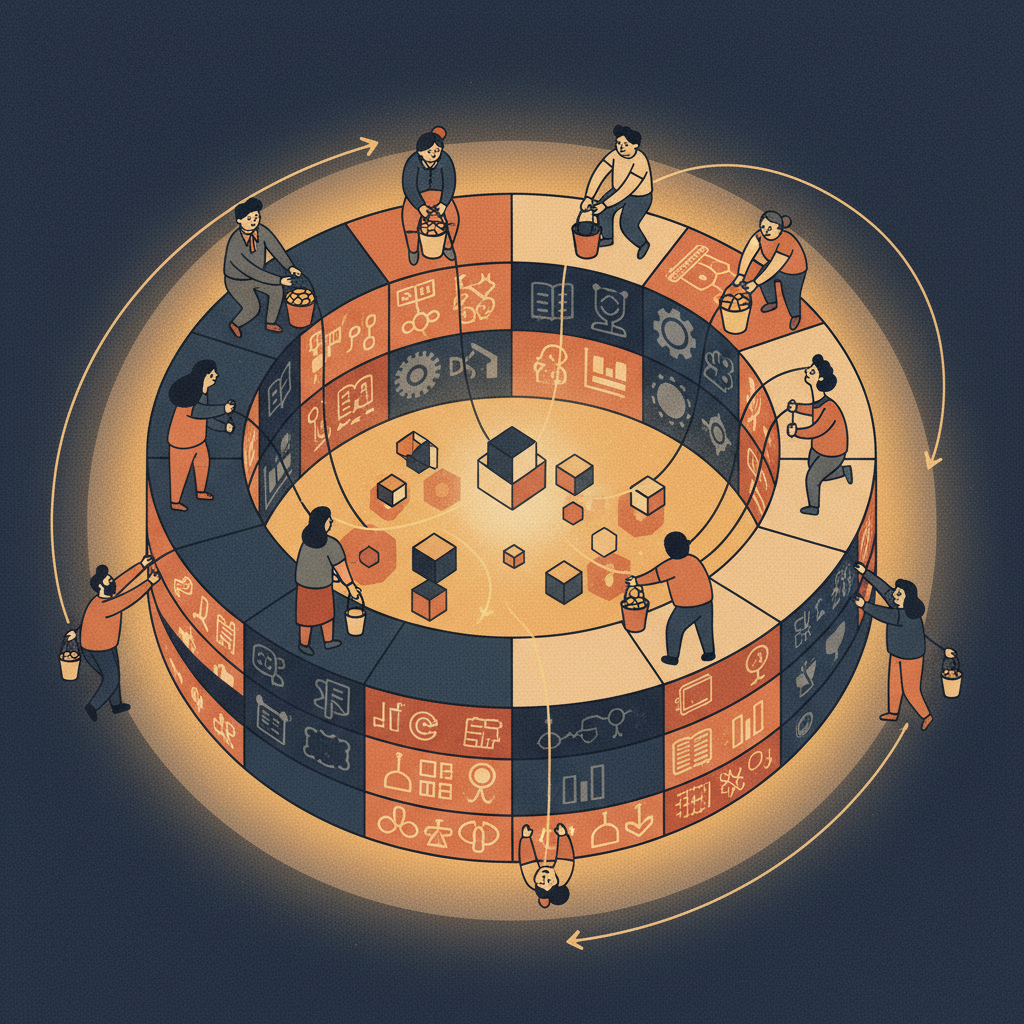
Token Costs
AI without cost discipline is a budget surprise waiting to happen. AI with clean cost tracking is how you stop reacting and start placing real bets.
How are you tracking them? How are you managing them?
Without this, you get whiplash. Underspend. Overspend. Pull back. Underspend again. Over and over.
I watched a sales leader sign off on a $30,000-a-month AI tool, then cancel it three months later because nobody had tracked what it actually replaced. Six weeks after that the team asked for a different tool that did the same job. That is the whiplash tax in practice - paid in wasted weeks, paid in trust, paid in time nobody wanted to spend. Compare that to an operations head who lists every team's AI spend in one shared table, reviews it monthly, and never gets surprised. Same companies. Same tools. Very different decisions.
Token spend touches every team. If you're not setting how it gets tracked from the top, every team tracks it differently, or not at all. You end up flying blind on a spend line that only gets bigger.
Token Value
AI without a way to measure value is just expensive vibes. AI with a clear read on spend vs outcomes is how you fund the work that's actually moving the business.
How does a team or an individual understand spend vs outcomes?
Every business will be different. But without some simple scaffolding, you'll struggle to know if $1K on tokens is the deal of the century or a waste of money.
Ask a founder what their AI spending actually produced last quarter and most can't answer beyond "the team is faster." Faster at what? Compared to what? Toward what?
A product leader I work with thinks about value in two columns and ignores anyone who only fills out the first. Column one is the obvious stuff - hours saved, headcount avoided, tasks compressed. Easy to measure. Easy to defend at a budget meeting. Uninteresting to her as a decision driver. Column two is the question she actually cares about: what can the team do this quarter that they could not have done last quarter? Not faster - different. Three sprints in, her marketing lead's answer ran like this: we can ship a positioning experiment the same day a competitor publishes their earnings; we can read patterns across our entire customer base instead of sampling the last fifteen calls; we can stress-test bets against six markets we never had the bandwidth to study. None of that fits on a spend-vs-savings spreadsheet. All of it is the actual return. When a tool only moves column one, she cuts it. When it moves column two, she doubles down even if column one says it's expensive.
What counts as value is a call only leadership can make. If you don't make it, your teams are guessing. And you're paying for the guesses.
That two-column thinking has a name: automation versus elevation. Column one - the easy math - plateaus. Column two - new capability, new KPI ceiling, new scope your team could not reach a quarter ago - compounds. Don't just automate. Elevate →
And here is the third dimension most leaders miss entirely: the bets. The same capacity that lets your team elevate also lets your business place wagers it could never have justified before. The team that tested two hypotheses a quarter can test fifty. The founder who explored one adjacent market can stress-test six. The product org that could afford one moonshot a year can run three. Most of those bets will not work - that is the math of asymmetric upside. But the one that does is not a 2x or a 10x. It is a 100x. That is the value most spreadsheets cannot see and most leaders never measure. The teams running asymmetric portfolios are not just outproducing the teams running optimization portfolios - they are landing in markets the optimizers never even tried to enter.
Leaders who fund compression alone are funding optimization. Leaders who fund elevation are funding compounding. Leaders who fund the bets too are funding the next decade.
AI will transform your business, but only if you can be more and more precise with where you fund the investments and the adventures.

Strong Soil, Thousand Flowers
Build these foundations and you're laying down strong soil. The ever-changing AI landscape will bloom a thousand flowers in it.
If I were starting tomorrow, I'd run it like this. One leader owns the knowledge layer and ships a single access point that pulls from every team. One leader owns token costs and stands up a shared tracking standard everyone reports into. One leader owns token value and defines what a good outcome looks like in your business, so teams can actually score their own work.
These foundations allow AI to flourish in your business and set you up with an incredible springboard.
What are you doing in your business to build these foundations?
Ask Yourself
These questions cut to whether you're leading AI usage or just picking tools alongside everyone else.
How wide and how deep is your knowledge layer right now? If a new team member joined tomorrow, could they pull the context they need from a single place - or are they hunting through five tools and three Slack channels? The single-access-layer question is the leadership test. See how the knowledge moat works →
Who owns token cost tracking in your org? If the answer is "every team tracks it differently" or "we'll figure that out at the next budget review," you're flying blind. The leader who stands up the shared tracking standard is the leader who stops the whiplash.
Can your teams tell you what a good AI outcome looks like in your business? Not generally - specifically. And not just "faster at the old work" - what new capability, what new KPI level, what new scope. If they can't, that's a value-definition gap, and only you can close it. Every guess they make is a guess you're funding. See how elevation beats automation →
Is your AI investment opening up bets you previously couldn't justify? The biggest wins from AI rarely show up in the savings column. They show up when your team can place wagers it could never afford before - more hypotheses tested, more markets explored, more moonshots in flight. If your AI spending is only producing 1-10x optimizations and never a 100x outlier, you are funding the safe lane and missing the prize.
Are you funding investments or adventures? Both have a place, but you need to know which is which. Without value scaffolding, every spend looks the same and the wrong ones survive the longest.
Can your product team's knowledge be pulled by your sales team's agents? If not, you have silos masquerading as a knowledge layer. The flow between teams is where compounding lives. Explore how collaborative spaces connect them →
If you were starting tomorrow, who would own each of the three foundations? Name them. If you can't, the foundations don't exist yet - you have three things nobody owns.